Showing posts with label weight loss foods. Show all posts
, , , , , , , , ,

Weight Loss For Women: Gross New Study Reports How Much Weight You Need to Lose for Others to Notice - Catherine's Blog

Gross New Study Reports How Much Weight You Need to Lose for Others to Notice


BY K. ALEISHA FETTERS 
After weeks and months of meal-prepping, healthy-recipe pinning, and sweat-soaked workout sessions, it feels pretty damn good when someone says, �Hey, you look great! Have you lost weight?�

But let�s get one thing straight: Even if the �atta girl�s are fun, they shouldn�t factor into your weight-loss motivation, body image, or how much you think you �should� weigh. If you are trying to lose weight, it should be for yourself. And your goal weight�although we aren�t fans of getting hung up on numbers�should be all about making you healthier and happier. (Here�s how to find your body�s happy weight.)
And here�s one more reason not to worry about what other people think: The average woman would have to lose about 14 pounds for her face to look more attractive to others, according to a recent study published in Social Psychological and Personality Science. Well, that's gotta be one of the foulest loads of b.s. we've ever smelled.
To figure out how peoples� faces become more or less attractive depending on their weights, researchers at the University of Toronto pulled together a bunch of photos of men�s and women�s faces, all of whom were in their twenties or thirties. The photos were then doctored to create photo sequences in which the person�s weight appeared to gradually change.

Study participants were then asked to randomly access the photos to pinpoint when they (1) noticed a change in weight and (2) found the people�s faces more attractive. The gag-inducing results found that women need to lose about eight pounds for anyone to notice�and 14 for others to find them more attractive. Men would have to lose about 18 to look more attractive. (At least, for once, people aren�t saying women need to lose more than men.)

While the study authors say that fat accumulation in the face is an indicator of overall health and that the study�s results may motivate people to start losing weight, we sure hope that people aren�t buying into this lose-weight-to-look-better line of thinking. Besides the fact that losing weight for others is damaging to any person�s self-worth, more and more research, including one Psychology and Health study, shows that people don�t stick to their workouts for very long when their main motivators are weight loss and looking more attractive.


So screw what everyone else thinks, and if you decide to switch up your plate, gym routine, or anything else, do it for you and your health�not other people's reactions. It'll feel so much better.

Source & Credit By :
http://www.womenshealthmag.com/weight-loss/gross-research-on-how-much-weight-women-should-lose

weight loss foods - Hello, My amazing 3010 Weight Loss For Life blog's readers. Nice to meet You again, today. Here, now. In this article titled, weight loss foods, you might find interesting information about what You looking for. Hopefully, the content from my Diet tips article fast weight loss article health & fitness article natural weight loss tips article rapid weight loss tips article Weight Loss article weight loss exercise article weight loss foods article weight loss programs article Weight loss tips article will bring you many advantages both in work and in life. Enjoy Your readings. ^_^

Title : Weight Loss For Women: Gross New Study Reports How Much Weight You Need to Lose for Others to Notice - Catherine's Blog
URL Link : Weight Loss For Women: Gross New Study Reports How Much Weight You Need to Lose for Others to Notice - Catherine's Blog

Related Articles:


weight loss foods

Gross New Study Reports How Much Weight You Need to Lose for Others to Notice


BY K. ALEISHA FETTERS 
After weeks and months of meal-prepping, healthy-recipe pinning, and sweat-soaked workout sessions, it feels pretty damn good when someone says, �Hey, you look great! Have you lost weight?�

But let�s get one thing straight: Even if the �atta girl�s are fun, they shouldn�t factor into your weight-loss motivation, body image, or how much you think you �should� weigh. If you are trying to lose weight, it should be for yourself. And your goal weight�although we aren�t fans of getting hung up on numbers�should be all about making you healthier and happier. (Here�s how to find your body�s happy weight.)
And here�s one more reason not to worry about what other people think: The average woman would have to lose about 14 pounds for her face to look more attractive to others, according to a recent study published in Social Psychological and Personality Science. Well, that's gotta be one of the foulest loads of b.s. we've ever smelled.
To figure out how peoples� faces become more or less attractive depending on their weights, researchers at the University of Toronto pulled together a bunch of photos of men�s and women�s faces, all of whom were in their twenties or thirties. The photos were then doctored to create photo sequences in which the person�s weight appeared to gradually change.

Study participants were then asked to randomly access the photos to pinpoint when they (1) noticed a change in weight and (2) found the people�s faces more attractive. The gag-inducing results found that women need to lose about eight pounds for anyone to notice�and 14 for others to find them more attractive. Men would have to lose about 18 to look more attractive. (At least, for once, people aren�t saying women need to lose more than men.)

While the study authors say that fat accumulation in the face is an indicator of overall health and that the study�s results may motivate people to start losing weight, we sure hope that people aren�t buying into this lose-weight-to-look-better line of thinking. Besides the fact that losing weight for others is damaging to any person�s self-worth, more and more research, including one Psychology and Health study, shows that people don�t stick to their workouts for very long when their main motivators are weight loss and looking more attractive.


So screw what everyone else thinks, and if you decide to switch up your plate, gym routine, or anything else, do it for you and your health�not other people's reactions. It'll feel so much better.

Source & Credit By :
http://www.womenshealthmag.com/weight-loss/gross-research-on-how-much-weight-women-should-lose

, , , , , ,

Weight Loss For Women: 50 Ways Greek Yogurt Can Help You Lose Weight - Catherine's Blog

50 Ways Greek Yogurt Can Help You Lose Weight

Creative (but ridiculously simple) healthy-eating hacks.
BY K. ALEISHA FETTERS December 1, 2015


Apart from tasting amazing, a one-cup serving of plain Greek yogurt contains 23 grams of slow-to-digest protein, which is critical for keeping you full, satisfied, and hunger pang-free�even when you�re cutting calories, says Laura Jeffers, R.D., of the Cleveland Clinic. And if you reach for non- or low-fat Greek yogurt, it only contains about 150 calories.

Plus, with loads of calcium, vitamin B12, and probiotics (look for �live and active cultures� on your label!), Greek yogurt can help keep you energized, prevent bloating, and ward off potentially weight-wrecking inflammation, she says. Excuse us while we run to Costco to grab a gallon of the stuff.
Though yogurt cup after plastic yogurt cup can get old really quick, this magical food is versatile and perfect for creating weight-loss friendly dips, sauces, and more. Check out these 50 (!) R.D.-approved Greek yogurt hacks you need in your life.

1. Mix Greek yogurt with taco seasoning, salsa, or onion soup mix for a yummy chip dip.

2. Use it in place of sour cream on top of chili, Mexican food, or baked potatoes.
3. Combine it with sugar-free Jell-O mix for a sweet, protein-rich treat.

4. Spread it on your sandwiches in place of mayo for less fat and more flavor.

5. Add Greek yogurt to smoothies and shakes for a powder-free protein boost.

6. Add it to mashed potatoes (or mashed cauliflower) for unbelievable creaminess.

7. Dip strawberries in Greek yogurt, and then freeze them for tasty treats. (Bonus points if you drizzle melted dark chocolate over them, too.)

8. Mix it with ranch-seasoning powder and a bit of milk for a low-cal take on ranch dressing.

9. Use it to cut down on the butter in your recipes. Tip: Instead of using one cup of butter, you can use a quarter-cup of Greek yogurt and a half-cup of butter.

10. Mix together Greek yogurt, fresh-squeezed lime juice, capers, and a pinch of salt and pepper for a quick sauce that goes great on salmon and chicken. 

11. Add shredded cheddar cheese and Greek yogurt to hot pasta, along with a little bit of hot pasta water for a quick take on mac and cheese.

12. In recipes, sub out sour cream one-to-one for Greek yogurt.

13. Top your waffles and pancakes with it for a creamy, low-sugar topping. Or mix it with syrup to cut down on the sugar on your plate.

14. Blend it with spices like curry powder or cinnamon, and add a dollop on top of soups for a creamy garnish.

15. Use Greek yogurt in recipes in place of oil. If the recipe calls for one cup of oil, use three-quarters of a cup of Greek yogurt.
16. Combine it with peanut or almond butter for a protein-rich fruit dip.

17. Spread it onto a wax paper-lined baking sheet, top with cranberries and pumpkin seeds, and freeze until firm. Break apart, and enjoy a healthy Greek yogurt bark.

18. Stir it up with cucumbers, garlic, and dill for an awesome homemade Tzatziki sauce.

19. For faux chocolate chip cookie dough that will satisfy all of your slumber-party cravings, mix Greek yogurt with peanut butter, maple syrup, vanilla extract, and chocolate chips.

20. Add it to your milk for soaking overnight oats or muesli. You'll get extra protein and creaminess.

21. Dish out a dollop of Greek yogurt to cut the spice in any Indian takeout meals.

22. Ditch the cream cheese, and use Greek yogurt (they equate one-to-one) in dessert recipes.

23. Flavor up your fish by combining plain Greek yogurt with lemon juice, a touch of olive oil, and minced garlic.

24. Add it to soups for a creamy consistency without all of the fat of heavy cream. Use it one-for-one in recipes.

25. Use it to lend some healthy creaminess to any pasta sauce recipe or jar. Tomato, pesto�it doesn�t matter!
26. Spice it up with cumin and cayenne, and then use it to top your fish tacos.

27. Use it in place of mayo in chicken, egg, tuna, or potato salad. One cup mayonnaise = one cup Greek yogurt.

28. Mix Greek yogurt with stevia and raw cocoa powder, and add fresh or frozen raspberries on top for a high-protein chocolate mousse.

29. Forgo buttermilk, and opt for Greek yogurt. One cup buttermilk = two-thirds of a cup of Greek yogurt + one quarter-cup of butter.

30. Mix Greek yogurt with finely chopped cucumbers and fresh dill for a beyond-the-basics baked potato topping.

31. Whip it with eggs for a fluffier, more satisfying scramble.

32. Mix it with steamed veggies, herbs, and some lemon juice for a side dish that actually fills you up. ***

33. Pop it in the freezer overnight (with sprinkles?) for fro-yo that doubles as a superfood.

34. Mix it with your favorite spices, and then marinate chicken in it for a juicier main dish.

35. Make deviled eggs a little less caloric by swapping out the mayo for Greek yogurt.

36. Spoon some yogurt into a baggie, snip the end, and squeeze dots onto a wax paper-lined cookie sheet. Once they�re frozen, just pop them off and into your fruit bowl.
37. Mix Greek yogurt with hummus for a protein-fiber power combo that goes great with pita, carrot sticks, cherry tomatoes, or anything else you have laying around the kitchen.

38. Stir a dollop into your favorite guac recipe. The result: OMG flavor for fewer calories.

39. Fold toasted coconut shreds into Greek yogurt for a yummy fruit dip that's just as easy as any cream-cheese concoction you could buy at the supermarket.

40. Mix with garlic and dill, and then use it as the perfect nest for your poached eggs instead of hollandaise. Sop it all up with whole-wheat bread.

41. Mix Greek yogurt with 100 percent fruit juice or frozen fruit, spoon it into ice cube trays, insert popsicle sticks, and pop them in the freezer for frozen sweet treats.

42. Health-ify your Nutella habit by combining it with a spoonful of Greek yogurt.

43. Stir it into your oatmeal to give the carbs a kick of protein.

44. Top your yogurt with beets, arugula, carrots�or any of your favorite veggies�to help you hit your five-a-day.

45. Spoon it into one half of a cantaloupe, and top with berries and nuts for a hearty fruit-based breakfast.

46. Make an even more energizing chia seed pudding by soaking chia seeds overnight in a mixture of almond milk, Greek yogurt, maple syrup, and vanilla.

47. Combine with minced herbs and olive oil for a bright yet rich salad dressing.

48. Stir it up with honey, lemon juice, and cinnamon for an awesome fruit topping.

49. Top pizza dough with Greek yogurt, either in place of or addition to marinara sauce for an extra creamy, satisfying pizza.

50. Mix Greek yogurt, a ripe banana, and cocoa powder for a nutrient-packed chocolate pudding.

Source & Credit By : 
http://www.womenshealthmag.com/weight-loss/greek-yogurt-for-weight-loss
weight loss foods - Hello, My amazing 3010 Weight Loss For Life blog's readers. Nice to meet You again, today. Here, now. In this article titled, weight loss foods, you might find interesting information about what You looking for. Hopefully, the content from my eight loss tips women article fast weight loss article meal plans for weight loss for women article weight loss exercise article weight loss foods article weight loss programs article weight watchers teenager article will bring you many advantages both in work and in life. Enjoy Your readings. ^_^

Title : Weight Loss For Women: 50 Ways Greek Yogurt Can Help You Lose Weight - Catherine's Blog
URL Link : Weight Loss For Women: 50 Ways Greek Yogurt Can Help You Lose Weight - Catherine's Blog

Related Articles:


weight loss foods

50 Ways Greek Yogurt Can Help You Lose Weight

Creative (but ridiculously simple) healthy-eating hacks.
BY K. ALEISHA FETTERS December 1, 2015


Apart from tasting amazing, a one-cup serving of plain Greek yogurt contains 23 grams of slow-to-digest protein, which is critical for keeping you full, satisfied, and hunger pang-free�even when you�re cutting calories, says Laura Jeffers, R.D., of the Cleveland Clinic. And if you reach for non- or low-fat Greek yogurt, it only contains about 150 calories.

Plus, with loads of calcium, vitamin B12, and probiotics (look for �live and active cultures� on your label!), Greek yogurt can help keep you energized, prevent bloating, and ward off potentially weight-wrecking inflammation, she says. Excuse us while we run to Costco to grab a gallon of the stuff.
Though yogurt cup after plastic yogurt cup can get old really quick, this magical food is versatile and perfect for creating weight-loss friendly dips, sauces, and more. Check out these 50 (!) R.D.-approved Greek yogurt hacks you need in your life.

1. Mix Greek yogurt with taco seasoning, salsa, or onion soup mix for a yummy chip dip.

2. Use it in place of sour cream on top of chili, Mexican food, or baked potatoes.
3. Combine it with sugar-free Jell-O mix for a sweet, protein-rich treat.

4. Spread it on your sandwiches in place of mayo for less fat and more flavor.

5. Add Greek yogurt to smoothies and shakes for a powder-free protein boost.

6. Add it to mashed potatoes (or mashed cauliflower) for unbelievable creaminess.

7. Dip strawberries in Greek yogurt, and then freeze them for tasty treats. (Bonus points if you drizzle melted dark chocolate over them, too.)

8. Mix it with ranch-seasoning powder and a bit of milk for a low-cal take on ranch dressing.

9. Use it to cut down on the butter in your recipes. Tip: Instead of using one cup of butter, you can use a quarter-cup of Greek yogurt and a half-cup of butter.

10. Mix together Greek yogurt, fresh-squeezed lime juice, capers, and a pinch of salt and pepper for a quick sauce that goes great on salmon and chicken. 

11. Add shredded cheddar cheese and Greek yogurt to hot pasta, along with a little bit of hot pasta water for a quick take on mac and cheese.

12. In recipes, sub out sour cream one-to-one for Greek yogurt.

13. Top your waffles and pancakes with it for a creamy, low-sugar topping. Or mix it with syrup to cut down on the sugar on your plate.

14. Blend it with spices like curry powder or cinnamon, and add a dollop on top of soups for a creamy garnish.

15. Use Greek yogurt in recipes in place of oil. If the recipe calls for one cup of oil, use three-quarters of a cup of Greek yogurt.
16. Combine it with peanut or almond butter for a protein-rich fruit dip.

17. Spread it onto a wax paper-lined baking sheet, top with cranberries and pumpkin seeds, and freeze until firm. Break apart, and enjoy a healthy Greek yogurt bark.

18. Stir it up with cucumbers, garlic, and dill for an awesome homemade Tzatziki sauce.

19. For faux chocolate chip cookie dough that will satisfy all of your slumber-party cravings, mix Greek yogurt with peanut butter, maple syrup, vanilla extract, and chocolate chips.

20. Add it to your milk for soaking overnight oats or muesli. You'll get extra protein and creaminess.

21. Dish out a dollop of Greek yogurt to cut the spice in any Indian takeout meals.

22. Ditch the cream cheese, and use Greek yogurt (they equate one-to-one) in dessert recipes.

23. Flavor up your fish by combining plain Greek yogurt with lemon juice, a touch of olive oil, and minced garlic.

24. Add it to soups for a creamy consistency without all of the fat of heavy cream. Use it one-for-one in recipes.

25. Use it to lend some healthy creaminess to any pasta sauce recipe or jar. Tomato, pesto�it doesn�t matter!
26. Spice it up with cumin and cayenne, and then use it to top your fish tacos.

27. Use it in place of mayo in chicken, egg, tuna, or potato salad. One cup mayonnaise = one cup Greek yogurt.

28. Mix Greek yogurt with stevia and raw cocoa powder, and add fresh or frozen raspberries on top for a high-protein chocolate mousse.

29. Forgo buttermilk, and opt for Greek yogurt. One cup buttermilk = two-thirds of a cup of Greek yogurt + one quarter-cup of butter.

30. Mix Greek yogurt with finely chopped cucumbers and fresh dill for a beyond-the-basics baked potato topping.

31. Whip it with eggs for a fluffier, more satisfying scramble.

32. Mix it with steamed veggies, herbs, and some lemon juice for a side dish that actually fills you up. ***

33. Pop it in the freezer overnight (with sprinkles?) for fro-yo that doubles as a superfood.

34. Mix it with your favorite spices, and then marinate chicken in it for a juicier main dish.

35. Make deviled eggs a little less caloric by swapping out the mayo for Greek yogurt.

36. Spoon some yogurt into a baggie, snip the end, and squeeze dots onto a wax paper-lined cookie sheet. Once they�re frozen, just pop them off and into your fruit bowl.
37. Mix Greek yogurt with hummus for a protein-fiber power combo that goes great with pita, carrot sticks, cherry tomatoes, or anything else you have laying around the kitchen.

38. Stir a dollop into your favorite guac recipe. The result: OMG flavor for fewer calories.

39. Fold toasted coconut shreds into Greek yogurt for a yummy fruit dip that's just as easy as any cream-cheese concoction you could buy at the supermarket.

40. Mix with garlic and dill, and then use it as the perfect nest for your poached eggs instead of hollandaise. Sop it all up with whole-wheat bread.

41. Mix Greek yogurt with 100 percent fruit juice or frozen fruit, spoon it into ice cube trays, insert popsicle sticks, and pop them in the freezer for frozen sweet treats.

42. Health-ify your Nutella habit by combining it with a spoonful of Greek yogurt.

43. Stir it into your oatmeal to give the carbs a kick of protein.

44. Top your yogurt with beets, arugula, carrots�or any of your favorite veggies�to help you hit your five-a-day.

45. Spoon it into one half of a cantaloupe, and top with berries and nuts for a hearty fruit-based breakfast.

46. Make an even more energizing chia seed pudding by soaking chia seeds overnight in a mixture of almond milk, Greek yogurt, maple syrup, and vanilla.

47. Combine with minced herbs and olive oil for a bright yet rich salad dressing.

48. Stir it up with honey, lemon juice, and cinnamon for an awesome fruit topping.

49. Top pizza dough with Greek yogurt, either in place of or addition to marinara sauce for an extra creamy, satisfying pizza.

50. Mix Greek yogurt, a ripe banana, and cocoa powder for a nutrient-packed chocolate pudding.

Source & Credit By : 
http://www.womenshealthmag.com/weight-loss/greek-yogurt-for-weight-loss

, , , , , , , , ,

Weight Loss For Women: 12 Ways to Burn More Calories During ANY Workout - Catherine's Blog

12 Ways to Burn More Calories During ANY Workout
Calorie torching on-fleek.
BY LAUREN DEL TURCO 
When you're trying to drop pounds, your workouts aren�t just a great way to blow off steam after a tough day; they're also a key part of reaching your goal weight. So what�s going to give you the most bang for your calorie-burning buck?

As it turns out, a weight-loss-friendly exercise regimen combines cardio and strength training, says Josh Kernen, C.S.C.S., co-owner of Bridgetown Physical Therapy and Training Studio in Portland, Oregon. But because you've got goals to reach, we asked the experts how you can make the most of every move�and machine�at the gym so you can max out your calorie burn.
1. Avoid Zombie Mode with Intervals

Whether you get your cardio fix by hopping on the elliptical, treadmill, or strength training, try going for a positive work-to-rest ratio, says Mike Wunsch, C.S.C.S., coach at Results Fitness in Newhall, California.. That means working at 80 to 90 percent of your maximum heart rate for 30 seconds and resting for 30 seconds at 70 percent of your max heart rate. (Use the sensors on the cardio machine or a wearable monitor to check in on your beats per minute.) When you train at a steady pace, you often put in a medium amount of effort in order to pace yourself through your workout. But when you use intervals, your heart rate goes much higher and spikes your calorie burn.
2. Limit Your Rest

Since burning calories is all about keeping your heart rate up, long rest periods are not your friend. Try to catch your breath during a 30- to 60-second break, says Kernen. Set a timer on your phone so you know exactly when it's time to push it again.

3. Don�t Use the Machine's Pre-Set �Weight-Loss� Program

The programs on cardio machines can take the guesswork out of your sweat session, but choose your program wisely. The �weight-loss� or �fat-loss� programs keep your heart rate at around 55 percent of your max, while the cardio program keeps your heart rate at around 75 of your max, says Kernen. That could be the difference between burning 200 calories or 400 calories, he says. The higher your heart rate, the more oxygen your body uses, and the more calories you burn. 
4. Hit the Hills

Sprinting isn�t the only way to get your heart rate up on the hamster wheel. Try increasing the incline on the treadmill between three and five percent instead of the cranking up the speed, says Kernen. The higher the incline, the more calories you�ll burn, even without going any faster. Plus, by taking your incline up a notch, you engage different muscles than you do on a flat road, which adds an extra challenge. As you get comfortable walking (keeping the speed below four mph) or jogging (with your speed between five and six mph) at that incline, you can gradually increase it. But look out for signs that you have the machine set too steep, he says. If you need to hold onto the treadmill, notice you�re falling farther back on the belt, or feel like you�re leaning too far forward, you need to bring the incline down a bit.
5. Stop Being Basic

You could slow the treadmill down to a brisk walk during your rest intervals�or you could try taking your speed way down (like between one and two mph) and performing walking lunges. Since lunging requires your quads, glutes, and lower back to exert much more force than they would while walking, you'll burn more energy during your break, says Kernan. 

6. Engage Your Arms

If you�re just resting your hands on the elliptical handles, your only working your lower body. But by pushing and pulling them with every stride, your muscles will suck more oxygen out of your blood stream, which forces your cardiovascular system to use more energy, says Wunsch. That means you�ll crush more calories.

7. Make Your Legs Multitask

When you vary the incline and the stride directions on the elliptical, you use different muscles. So while some muscles work, others rest. That allows you to exercise at a higher intensity for longer, which, you guessed it, helps crush calories, says Kernen. In the flat position, your quads do most of the work, he says. And in the max incline position, your glutes and calves take charge. To get the most out of this machine, alternate between the flat position and the max incline. Then, to get your hamstrings in on the action, add intervals of backward strides.  

8. Check Your Pedaling Form

A lot of people just push down on the pedals and don�t think about the upstroke. But when you focus on pulling the pedals up, too, you engage your hip flexors, which are typically neglected, he says. By focusing on the pulling and pushing motion, you'll involve more muscles and also be able to cycle faster. (By now you probably know that the more muscles you use, the harder your heart has to work to transport oxygen to them, and�voila�you burn more calories.)

9. Get On Your Feet

The easiest way to work more leg muscles and use more energy on the bike is to stand up. When you sit down and pedal away, your quads do most of the work, but when you get up, you activate your calves and core, as well. 

10. Don�t Latch onto the Hand Rails

Remember what we said about the treadmill? The same goes for the stair-stepper. If you use your arms to hold yourself up, it makes climbing easier because your legs aren't doing the work they should be. That means the machine thinks you're putting in more effort than you are�and you burn fewer calories than that blinking screen estimates, he says. Bend your elbows, and just rest your fingertips on the handrail. Don�t put any weight in your hands, he says.

11. Use Supersets

Instead of resting between sets of moves, perform exercises that work different muscle groups back-to-back. This way, your lower-body muscles will have a chance to recover while your upper-body muscles will keep chugging along. And since you�re never coming to a standstill, your heart rate stays in the calorie-burning zone, he says. So if you�re going to do three sets of 10 deadlifts and three sets of 10 pushups, do 10 deadlifts, then 10 pushups, and repeat,� says Wunsch. You�ll make your workout much more efficient.

12. Trade Machines for Compound Movements

If you�re looking to kick your own butt, using resistance machines won�t quite do it for you. When you sit on a machine, your glutes aren�t activated, your hips get tight, and only one muscle is working at a time, says Wunsch. Swap out the machines for exercises that get as many joints moving as possible, like the squat to press or lunge to bicep curl. Those moves engage your core, improve your balance, and strengthen more than one muscle group.

Source & Credit By:

weight loss foods - Hello, My amazing 3010 Weight Loss For Life blog's readers. Nice to meet You again, today. Here, now. In this article titled, weight loss foods, you might find interesting information about what You looking for. Hopefully, the content from my Diet tips article fast weight loss article health & fitness article natural weight loss tips article rapid weight loss tips article Weight Loss article weight loss exercise article weight loss foods article weight loss programs article Weight loss tips article will bring you many advantages both in work and in life. Enjoy Your readings. ^_^

Title : Weight Loss For Women: 12 Ways to Burn More Calories During ANY Workout - Catherine's Blog
URL Link : Weight Loss For Women: 12 Ways to Burn More Calories During ANY Workout - Catherine's Blog

Related Articles:


weight loss foods

12 Ways to Burn More Calories During ANY Workout
Calorie torching on-fleek.
BY LAUREN DEL TURCO 
When you're trying to drop pounds, your workouts aren�t just a great way to blow off steam after a tough day; they're also a key part of reaching your goal weight. So what�s going to give you the most bang for your calorie-burning buck?

As it turns out, a weight-loss-friendly exercise regimen combines cardio and strength training, says Josh Kernen, C.S.C.S., co-owner of Bridgetown Physical Therapy and Training Studio in Portland, Oregon. But because you've got goals to reach, we asked the experts how you can make the most of every move�and machine�at the gym so you can max out your calorie burn.
1. Avoid Zombie Mode with Intervals

Whether you get your cardio fix by hopping on the elliptical, treadmill, or strength training, try going for a positive work-to-rest ratio, says Mike Wunsch, C.S.C.S., coach at Results Fitness in Newhall, California.. That means working at 80 to 90 percent of your maximum heart rate for 30 seconds and resting for 30 seconds at 70 percent of your max heart rate. (Use the sensors on the cardio machine or a wearable monitor to check in on your beats per minute.) When you train at a steady pace, you often put in a medium amount of effort in order to pace yourself through your workout. But when you use intervals, your heart rate goes much higher and spikes your calorie burn.
2. Limit Your Rest

Since burning calories is all about keeping your heart rate up, long rest periods are not your friend. Try to catch your breath during a 30- to 60-second break, says Kernen. Set a timer on your phone so you know exactly when it's time to push it again.

3. Don�t Use the Machine's Pre-Set �Weight-Loss� Program

The programs on cardio machines can take the guesswork out of your sweat session, but choose your program wisely. The �weight-loss� or �fat-loss� programs keep your heart rate at around 55 percent of your max, while the cardio program keeps your heart rate at around 75 of your max, says Kernen. That could be the difference between burning 200 calories or 400 calories, he says. The higher your heart rate, the more oxygen your body uses, and the more calories you burn. 
4. Hit the Hills

Sprinting isn�t the only way to get your heart rate up on the hamster wheel. Try increasing the incline on the treadmill between three and five percent instead of the cranking up the speed, says Kernen. The higher the incline, the more calories you�ll burn, even without going any faster. Plus, by taking your incline up a notch, you engage different muscles than you do on a flat road, which adds an extra challenge. As you get comfortable walking (keeping the speed below four mph) or jogging (with your speed between five and six mph) at that incline, you can gradually increase it. But look out for signs that you have the machine set too steep, he says. If you need to hold onto the treadmill, notice you�re falling farther back on the belt, or feel like you�re leaning too far forward, you need to bring the incline down a bit.
5. Stop Being Basic

You could slow the treadmill down to a brisk walk during your rest intervals�or you could try taking your speed way down (like between one and two mph) and performing walking lunges. Since lunging requires your quads, glutes, and lower back to exert much more force than they would while walking, you'll burn more energy during your break, says Kernan. 

6. Engage Your Arms

If you�re just resting your hands on the elliptical handles, your only working your lower body. But by pushing and pulling them with every stride, your muscles will suck more oxygen out of your blood stream, which forces your cardiovascular system to use more energy, says Wunsch. That means you�ll crush more calories.

7. Make Your Legs Multitask

When you vary the incline and the stride directions on the elliptical, you use different muscles. So while some muscles work, others rest. That allows you to exercise at a higher intensity for longer, which, you guessed it, helps crush calories, says Kernen. In the flat position, your quads do most of the work, he says. And in the max incline position, your glutes and calves take charge. To get the most out of this machine, alternate between the flat position and the max incline. Then, to get your hamstrings in on the action, add intervals of backward strides.  

8. Check Your Pedaling Form

A lot of people just push down on the pedals and don�t think about the upstroke. But when you focus on pulling the pedals up, too, you engage your hip flexors, which are typically neglected, he says. By focusing on the pulling and pushing motion, you'll involve more muscles and also be able to cycle faster. (By now you probably know that the more muscles you use, the harder your heart has to work to transport oxygen to them, and�voila�you burn more calories.)

9. Get On Your Feet

The easiest way to work more leg muscles and use more energy on the bike is to stand up. When you sit down and pedal away, your quads do most of the work, but when you get up, you activate your calves and core, as well. 

10. Don�t Latch onto the Hand Rails

Remember what we said about the treadmill? The same goes for the stair-stepper. If you use your arms to hold yourself up, it makes climbing easier because your legs aren't doing the work they should be. That means the machine thinks you're putting in more effort than you are�and you burn fewer calories than that blinking screen estimates, he says. Bend your elbows, and just rest your fingertips on the handrail. Don�t put any weight in your hands, he says.

11. Use Supersets

Instead of resting between sets of moves, perform exercises that work different muscle groups back-to-back. This way, your lower-body muscles will have a chance to recover while your upper-body muscles will keep chugging along. And since you�re never coming to a standstill, your heart rate stays in the calorie-burning zone, he says. So if you�re going to do three sets of 10 deadlifts and three sets of 10 pushups, do 10 deadlifts, then 10 pushups, and repeat,� says Wunsch. You�ll make your workout much more efficient.

12. Trade Machines for Compound Movements

If you�re looking to kick your own butt, using resistance machines won�t quite do it for you. When you sit on a machine, your glutes aren�t activated, your hips get tight, and only one muscle is working at a time, says Wunsch. Swap out the machines for exercises that get as many joints moving as possible, like the squat to press or lunge to bicep curl. Those moves engage your core, improve your balance, and strengthen more than one muscle group.

Source & Credit By:

, , , , , , ,

Weight Loss For Women: 10 Ways to Stay on Track with Your Weight-Loss Goals No Matter What - Catherine's Blog

10 Ways to Stay on Track with Your Weight-Loss Goals No Matter What

BY POPSUGAR December 14, 2015
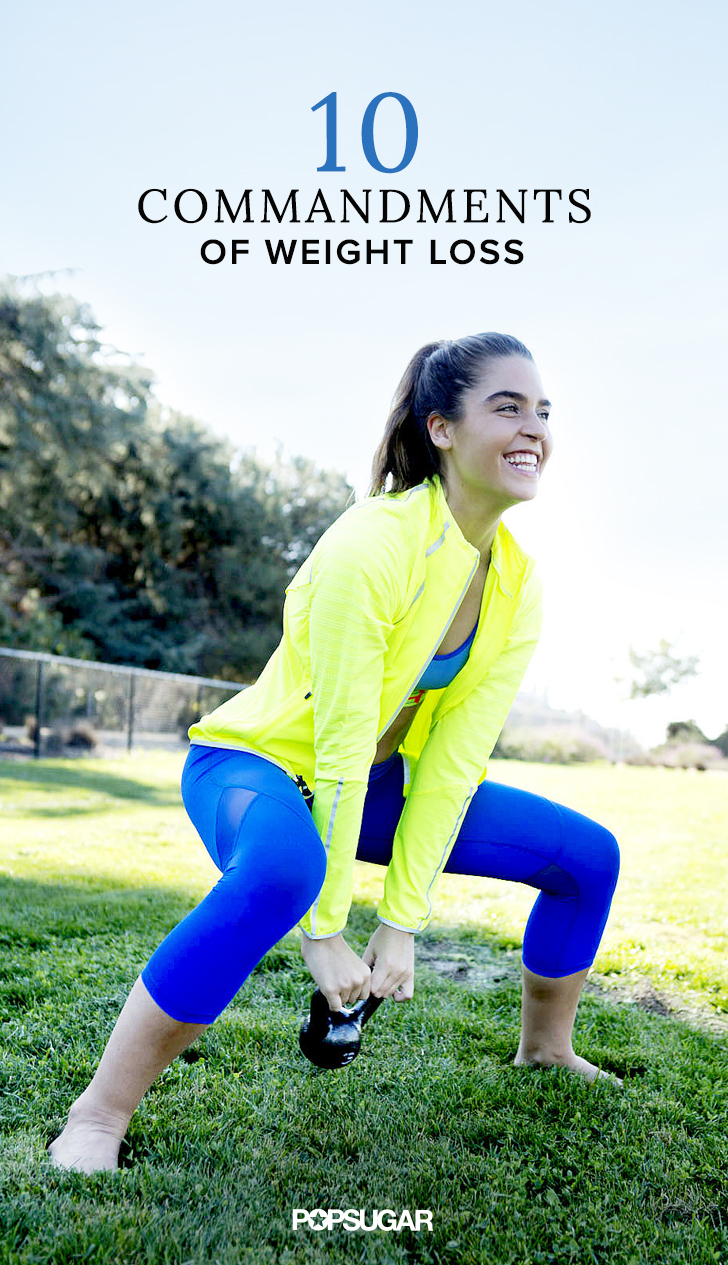
There's no magic bullet or secret pill � sustainable weight loss does not happen overnight. If want to take off weight and keep it off for good, some major healthy lifestyle changes need to occur in order for your results to last. Here are the 10 rules to live by every day.

1. Thou Shalt Eat Breakfast

Healthy foodie trends may come and go, but breakfast is a must. People who eat breakfast regularly lose more weight, since it jump-starts your metabolism, helping your body to burn more fat. With that said, any old breakfast won't do! Follow this nutritionist-approved weight-loss breakfast formula to choose yours wisely and start seeing results sooner.

2. Thou Shalt Keep It Clean

One of the very fastest ways to see and feel results is to cut out processed foods and fill up on fresh foods straight from the Earth. Whenever possible, opt for whole, natural foods and follow our clean eating dos and don'ts. Once you clean up your diet and cut out the junk, you'll start feeling and seeing enormous changes. After a few weeks, you'll wonder how you ever ate any other way.

3. Thou Shalt Control Portions

Even when you choose healthy foods, overeating these good-for-you choices can sabotage your weight-loss goals, and you might not even realize you're overdoing it. Use this handy printable chart to start learning about just how much constitutes one serving, or instead of eyeballing your meals, pick up some portion-control products so you can be as precise as possible.

4. Thou Shalt Welcome a Sweaty Workout Session

When it comes to working out and losing weight, 15 minutes a few times a week is simply not enough. For her clients who want to lose weight, Michelle Bridges of The Biggest Loser Australia recommends working out "six days a week, ideally for 50 to 60 minutes at a time," and you can't be afraid to go intense, feel the burn, and build up a sweat. Your clothes should not be dry when you leave the gym! Not every workout has to be a crazy sweat session, but Michelle says three of your workouts every week should be "hard" exercise like interval training in order to see results.

5. Thou Shalt Set Minigoals

As you move along on your weight-loss journey, there is so much more to revel in beyond a tiny number on the scale. Setting specific and personal minigoals like training for a race, slipping into the old pair of jeans, or grabbing heavier weights will help you stay connected and realize just how much progress you're making every day. These may seem like small wins, but they're absolutely worth celebrating.
6. Thou Shalt Drink (More) Water

You'd be surprised just how many people confuse hunger with dehydration. Keeping your water bottle full all day long keeps your body in tip-top shape and helps you steer clear of unnecessary snacking. To maximize your water intake for weight loss, dietitian Julie Upton, MS, RD, recommends "drinking about half of your body weight in fluid ounces of water (or other calorie-free beverages). Cold water provides a brief shock to your metabolism, raising it by about 30 percent so that over the course of a day, your body will burn about 100 more calories."

7. Thou Shalt Plan Ahead

Occasionally enjoying a sweet treat or special meal out are essential parts of any sustainable weight-loss plan, but it only works when you're realistic about your indulgences and learn to plan ahead. Heading to the beach next weekend? Keep your diet extraclean leading up to your getaway. This way you have a little more wiggle room to enjoy as you please. We're big believers in the 80/20 rule over here; eighty percent of the time you keep your diet clean and the other 20 percent of the day you're able to indulge freely. The math is simple: if you eat three square meals a day, three of those meals are the 20 percent of your week up for grabs.

8. Thou Shalt Strength Train

If you were fed the myth that strength training impedes weight loss and messes with results, it's time to change your tune. Strength training builds muscle mass while boosting your metabolism. You might not tip the scale, but strength training is where the real resculpting of your body happens. Once you start lifting and moving through bodyweight moves at home, you'll be hooked.

9. Thou Shalt Rest Well

Getting adequate sleep every night makes sure you have the energy to power through your workout, but it's also been proven to help curb a ravenous appetite, since those who get adequate sleep eat an average of 300 calories less than those who don't. Sleep also surprisingly fights against "fat" genes. In one study that looked at twins, the twin who slept longer had a lower BMI than the twin who did not. In short? Wind down and get to bed earlier. Your body thanks you in advance for supporting all its hard work in the kitchen and the gym.

10. Thou Shalt Remain Positive

When you treat yourself with kindness, you're able to bounce back faster and stay on track for longer. Keep a healthy sense of humor, leave room to laugh, and take it day by day. Every experience won't be perfect, but when you're kind to yourself and keep a positive outlook, this whole weight-loss thing will feel a lot easier.

Source & Credit By :

weight loss foods - Hello, My amazing 3010 Weight Loss For Life blog's readers. Nice to meet You again, today. Here, now. In this article titled, weight loss foods, you might find interesting information about what You looking for. Hopefully, the content from my fast weight loss article weight loss exercise article weight loss foods article weight loss for women article weight loss pills article weight loss programs article weight loss supplements article weight loss supplements for women article will bring you many advantages both in work and in life. Enjoy Your readings. ^_^

Title : Weight Loss For Women: 10 Ways to Stay on Track with Your Weight-Loss Goals No Matter What - Catherine's Blog
URL Link : Weight Loss For Women: 10 Ways to Stay on Track with Your Weight-Loss Goals No Matter What - Catherine's Blog

Related Articles:


weight loss foods

10 Ways to Stay on Track with Your Weight-Loss Goals No Matter What

BY POPSUGAR December 14, 2015
There's no magic bullet or secret pill � sustainable weight loss does not happen overnight. If want to take off weight and keep it off for good, some major healthy lifestyle changes need to occur in order for your results to last. Here are the 10 rules to live by every day.

1. Thou Shalt Eat Breakfast

Healthy foodie trends may come and go, but breakfast is a must. People who eat breakfast regularly lose more weight, since it jump-starts your metabolism, helping your body to burn more fat. With that said, any old breakfast won't do! Follow this nutritionist-approved weight-loss breakfast formula to choose yours wisely and start seeing results sooner.

2. Thou Shalt Keep It Clean

One of the very fastest ways to see and feel results is to cut out processed foods and fill up on fresh foods straight from the Earth. Whenever possible, opt for whole, natural foods and follow our clean eating dos and don'ts. Once you clean up your diet and cut out the junk, you'll start feeling and seeing enormous changes. After a few weeks, you'll wonder how you ever ate any other way.

3. Thou Shalt Control Portions

Even when you choose healthy foods, overeating these good-for-you choices can sabotage your weight-loss goals, and you might not even realize you're overdoing it. Use this handy printable chart to start learning about just how much constitutes one serving, or instead of eyeballing your meals, pick up some portion-control products so you can be as precise as possible.

4. Thou Shalt Welcome a Sweaty Workout Session

When it comes to working out and losing weight, 15 minutes a few times a week is simply not enough. For her clients who want to lose weight, Michelle Bridges of The Biggest Loser Australia recommends working out "six days a week, ideally for 50 to 60 minutes at a time," and you can't be afraid to go intense, feel the burn, and build up a sweat. Your clothes should not be dry when you leave the gym! Not every workout has to be a crazy sweat session, but Michelle says three of your workouts every week should be "hard" exercise like interval training in order to see results.

5. Thou Shalt Set Minigoals

As you move along on your weight-loss journey, there is so much more to revel in beyond a tiny number on the scale. Setting specific and personal minigoals like training for a race, slipping into the old pair of jeans, or grabbing heavier weights will help you stay connected and realize just how much progress you're making every day. These may seem like small wins, but they're absolutely worth celebrating.
6. Thou Shalt Drink (More) Water

You'd be surprised just how many people confuse hunger with dehydration. Keeping your water bottle full all day long keeps your body in tip-top shape and helps you steer clear of unnecessary snacking. To maximize your water intake for weight loss, dietitian Julie Upton, MS, RD, recommends "drinking about half of your body weight in fluid ounces of water (or other calorie-free beverages). Cold water provides a brief shock to your metabolism, raising it by about 30 percent so that over the course of a day, your body will burn about 100 more calories."

7. Thou Shalt Plan Ahead

Occasionally enjoying a sweet treat or special meal out are essential parts of any sustainable weight-loss plan, but it only works when you're realistic about your indulgences and learn to plan ahead. Heading to the beach next weekend? Keep your diet extraclean leading up to your getaway. This way you have a little more wiggle room to enjoy as you please. We're big believers in the 80/20 rule over here; eighty percent of the time you keep your diet clean and the other 20 percent of the day you're able to indulge freely. The math is simple: if you eat three square meals a day, three of those meals are the 20 percent of your week up for grabs.

8. Thou Shalt Strength Train

If you were fed the myth that strength training impedes weight loss and messes with results, it's time to change your tune. Strength training builds muscle mass while boosting your metabolism. You might not tip the scale, but strength training is where the real resculpting of your body happens. Once you start lifting and moving through bodyweight moves at home, you'll be hooked.

9. Thou Shalt Rest Well

Getting adequate sleep every night makes sure you have the energy to power through your workout, but it's also been proven to help curb a ravenous appetite, since those who get adequate sleep eat an average of 300 calories less than those who don't. Sleep also surprisingly fights against "fat" genes. In one study that looked at twins, the twin who slept longer had a lower BMI than the twin who did not. In short? Wind down and get to bed earlier. Your body thanks you in advance for supporting all its hard work in the kitchen and the gym.

10. Thou Shalt Remain Positive

When you treat yourself with kindness, you're able to bounce back faster and stay on track for longer. Keep a healthy sense of humor, leave room to laugh, and take it day by day. Every experience won't be perfect, but when you're kind to yourself and keep a positive outlook, this whole weight-loss thing will feel a lot easier.

Source & Credit By :

, , , , , , ,

Weight Loss For Women: Five myths on dieting and weight loss - Catherine's Blog

Five myths on dieting and weight loss

By Kevin D. Hall


Obesity has been on the rise worldwide for decades, putting people at risk for developing diabetes, heart disease and several forms of cancer. Today, two thirds of adults and one third of children in the United States are overweight. As the numbers on the scale get bigger, so does the diet and weight-loss industry, which is now worth tens of billions of dollars. What doesn�t seem to be increasing, though, is people�s understanding of obesity and how to lose weight. Here are a few of the myths clouding the facts.
1. Body mass index is useless.

The body mass index, or BMI, is a simple and widely used method for classifying whether a person is overweight or obese. It�s calculated by dividing a person�s body weight by height squared, which helps account for the fact that taller people weigh disproportionately more than shorter people if they have the same percentage of body fat.

BMI is often criticized because it doesn�t differentiate muscle from fat. Muscular people can therefore erroneously be classified as overweight. For example, Dallas Cowboys quarterback Tony Romo�s BMI makes him borderline obese.
But despite its limitations and notorious counter-examples, BMI is highly related to body fat and correctly categorizes people as having excess body fat more than 80 percent of the time. Additional simple measurements such as waist circumference may be even more informative because they provide information about where fat is distributed in the body.
2. All people with obesity are unhealthy.

The idea that people with obesity can�t be healthy has been repeated widely. CNN told readers that there�s �no such thing� as healthy obesity. Forbes called it �a myth.� �You can�t be fit and fat,� Time reported.

But in reality, fat�s location in the body may be more important for health than the total amount of fat. People who are �pear-shaped� tend to store fat in their buttocks and flanks and are at less risk of disease than those who are �apple-shaped� and tend to accumulate fat around the belly. Especially bad is the �visceral fat� around the organs as well as the fat in the liver. So being obese but pear-shaped may be less risky than being overweight or normal weight but apple-shaped. This realization has led to the recent concept of �metabolically healthy obesity.�

Genetics primarily determine where fat is stored in the body. Men, especially those with South Asian ethnic backgrounds, have a greater proportion of the dangerous visceral fat than women. Targeting the loss of body fat from one region to another is difficult, but overall weight loss results in predictable parallel reductions of all of the various fat deposits.

Additionally, exercise may help counterbalance obesity�s negative effect on health. Physically fit and active people who are obese have a similar or decreased risk of cardiovascular disease and death as people who are less fat but also less fit. Therefore, physical inactivity may be as great a risk to health as obesity, and people should be encouraged to be active even if it doesn�t result in weight loss.

3. Having a healthy body weight is all about personal responsibility and willpower.

People of normal weight sometimes like to take credit for avoiding obesity, suggesting that fatness arises from some combination of gluttony and sloth. As all those medical experts on Internet comment sections recommend, just eat less and exercise more!

Alas, if only such advice were effective. Consider exercise. Even when people participate in a supervised exercise program, weight loss is much less than would be expected from the calories burned during exercise. On average, exercising women experience no weight loss, and many people actually gain weight. This may be the result of compensatory decreases in other physical activities � such as collapsing on the couch for a few hours after a 30-minute run. Alternatively, hunger may increase, and it doesn�t take much food to offset the calories expended during exercise.

Why not just count calories and eat less? Unfortunately, even with the best diet-tracking apps, people tend to greatly underestimate how much food they consume. Furthermore, calorie intake tends to fluctuate widely, with swings often exceeding 1,000 calories from one day to the next. How would someone know if they made a dent in their calorie intake using such imperfect tools? Of course, making large calorie cuts would be easier to detect, and this is what most people do when they �go on a diet� to lose weight. When this happens, biology resists weight loss by increasing appetite and hunger.


4. Dieting causes the body to go into �starvation mode,� slowing its metabolism and halting weight loss after several months.

The idea that dieting can actually be counterproductive for weight loss is a trope that appears in just about every fitness publication, and warnings of the weight-loss plateau abound.

But although it�s true that metabolism does slow down when people cut calories, that offsets less than half of the decrease in diet calories over the first six months. It takes several years for metabolic slowing to fully offset the average dieter�s reduction in calories and result in a weight plateau. The fact that most people experience a weight plateau much earlier, typically after six to eight months of dieting, means that something else must be happening to thwart their continued weight loss.

In truth, the dreaded weight plateau is much more likely the result of a gradual loss of adherence to the original plan � people are actually eating many more calories when their weight loss stalls than when they started to diet. Why this happens is not fully understood, but biology probably plays a major role. For example, we know that weight loss results in hormonal changes that influence feelings of hunger and fullness, as well as alter how the brain responds to food cues in the environment. Food may actually become more rewarding. These changes influence overall food intake and may occur below our level of conscious awareness. People, therefore, may honestly report that they are sticking to their original diet when the weight plateau occurs, but objective measurements demonstrate otherwise.

5. All diets are doomed to fail.

�Beware of diet,� Slate warns, noting that your chance of keeping the pounds off is no higher than it is of surviving metastatic lung cancer. Even actress Gwyneth Paltrow�s Goop lifestyle Web site warns that most weight-loss efforts are doomed.

This myth exists because, statistically, most people tend to regain at least some portion of their lost weight after a few years. This is especially true if they consider dieting a temporary strategy for losing weight. However, when diet changes are part of a persistent lifestyle modification, many people lose weight and keep it off over the long haul.

A recent study showed that eight years after adults began a diet and exercise program, more than half maintained weight loss of greater than 5 percent � an amount believed to be clinically beneficial. Furthermore, almost 40 percent of people lost more than 10 percent of their initial body weight after one year, and about 65 percent of those maintained more than 5 percent weight loss after eight years.

In addition to frequent weight monitoring, the secret to their success may be physical activity. Although exercise may not be very effective for inducing weight loss, it�s often a major contributor to maintaining lost weight. This may be because, compared to losing weight, only a relatively modest change in calories is required to keep weight off.

For example, the National Institutes of Health�s Body Weight Planner calculates that a 40-year-old woman who weighs 200 pounds requires a little more than 1,000 calories to be cut from her daily diet to lose 40 pounds in six months. But subsequently maintaining the 40-pound weight loss requires a permanent change of only about 350 calories per day, which can be attained with one hour of daily walking.
Source & Credit By :

weight loss foods - Hello, My amazing 3010 Weight Loss For Life blog's readers. Nice to meet You again, today. Here, now. In this article titled, weight loss foods, you might find interesting information about what You looking for. Hopefully, the content from my fast weight loss article weight loss exercise article weight loss foods article weight loss for women article weight loss pills article weight loss programs article weight loss supplements article weight loss supplements for women article will bring you many advantages both in work and in life. Enjoy Your readings. ^_^

Title : Weight Loss For Women: Five myths on dieting and weight loss - Catherine's Blog
URL Link : Weight Loss For Women: Five myths on dieting and weight loss - Catherine's Blog

Related Articles:


weight loss foods

Five myths on dieting and weight loss

By Kevin D. Hall


Obesity has been on the rise worldwide for decades, putting people at risk for developing diabetes, heart disease and several forms of cancer. Today, two thirds of adults and one third of children in the United States are overweight. As the numbers on the scale get bigger, so does the diet and weight-loss industry, which is now worth tens of billions of dollars. What doesn�t seem to be increasing, though, is people�s understanding of obesity and how to lose weight. Here are a few of the myths clouding the facts.
1. Body mass index is useless.

The body mass index, or BMI, is a simple and widely used method for classifying whether a person is overweight or obese. It�s calculated by dividing a person�s body weight by height squared, which helps account for the fact that taller people weigh disproportionately more than shorter people if they have the same percentage of body fat.

BMI is often criticized because it doesn�t differentiate muscle from fat. Muscular people can therefore erroneously be classified as overweight. For example, Dallas Cowboys quarterback Tony Romo�s BMI makes him borderline obese.
But despite its limitations and notorious counter-examples, BMI is highly related to body fat and correctly categorizes people as having excess body fat more than 80 percent of the time. Additional simple measurements such as waist circumference may be even more informative because they provide information about where fat is distributed in the body.
2. All people with obesity are unhealthy.

The idea that people with obesity can�t be healthy has been repeated widely. CNN told readers that there�s �no such thing� as healthy obesity. Forbes called it �a myth.� �You can�t be fit and fat,� Time reported.

But in reality, fat�s location in the body may be more important for health than the total amount of fat. People who are �pear-shaped� tend to store fat in their buttocks and flanks and are at less risk of disease than those who are �apple-shaped� and tend to accumulate fat around the belly. Especially bad is the �visceral fat� around the organs as well as the fat in the liver. So being obese but pear-shaped may be less risky than being overweight or normal weight but apple-shaped. This realization has led to the recent concept of �metabolically healthy obesity.�

Genetics primarily determine where fat is stored in the body. Men, especially those with South Asian ethnic backgrounds, have a greater proportion of the dangerous visceral fat than women. Targeting the loss of body fat from one region to another is difficult, but overall weight loss results in predictable parallel reductions of all of the various fat deposits.

Additionally, exercise may help counterbalance obesity�s negative effect on health. Physically fit and active people who are obese have a similar or decreased risk of cardiovascular disease and death as people who are less fat but also less fit. Therefore, physical inactivity may be as great a risk to health as obesity, and people should be encouraged to be active even if it doesn�t result in weight loss.

3. Having a healthy body weight is all about personal responsibility and willpower.

People of normal weight sometimes like to take credit for avoiding obesity, suggesting that fatness arises from some combination of gluttony and sloth. As all those medical experts on Internet comment sections recommend, just eat less and exercise more!

Alas, if only such advice were effective. Consider exercise. Even when people participate in a supervised exercise program, weight loss is much less than would be expected from the calories burned during exercise. On average, exercising women experience no weight loss, and many people actually gain weight. This may be the result of compensatory decreases in other physical activities � such as collapsing on the couch for a few hours after a 30-minute run. Alternatively, hunger may increase, and it doesn�t take much food to offset the calories expended during exercise.

Why not just count calories and eat less? Unfortunately, even with the best diet-tracking apps, people tend to greatly underestimate how much food they consume. Furthermore, calorie intake tends to fluctuate widely, with swings often exceeding 1,000 calories from one day to the next. How would someone know if they made a dent in their calorie intake using such imperfect tools? Of course, making large calorie cuts would be easier to detect, and this is what most people do when they �go on a diet� to lose weight. When this happens, biology resists weight loss by increasing appetite and hunger.


4. Dieting causes the body to go into �starvation mode,� slowing its metabolism and halting weight loss after several months.

The idea that dieting can actually be counterproductive for weight loss is a trope that appears in just about every fitness publication, and warnings of the weight-loss plateau abound.

But although it�s true that metabolism does slow down when people cut calories, that offsets less than half of the decrease in diet calories over the first six months. It takes several years for metabolic slowing to fully offset the average dieter�s reduction in calories and result in a weight plateau. The fact that most people experience a weight plateau much earlier, typically after six to eight months of dieting, means that something else must be happening to thwart their continued weight loss.

In truth, the dreaded weight plateau is much more likely the result of a gradual loss of adherence to the original plan � people are actually eating many more calories when their weight loss stalls than when they started to diet. Why this happens is not fully understood, but biology probably plays a major role. For example, we know that weight loss results in hormonal changes that influence feelings of hunger and fullness, as well as alter how the brain responds to food cues in the environment. Food may actually become more rewarding. These changes influence overall food intake and may occur below our level of conscious awareness. People, therefore, may honestly report that they are sticking to their original diet when the weight plateau occurs, but objective measurements demonstrate otherwise.

5. All diets are doomed to fail.

�Beware of diet,� Slate warns, noting that your chance of keeping the pounds off is no higher than it is of surviving metastatic lung cancer. Even actress Gwyneth Paltrow�s Goop lifestyle Web site warns that most weight-loss efforts are doomed.

This myth exists because, statistically, most people tend to regain at least some portion of their lost weight after a few years. This is especially true if they consider dieting a temporary strategy for losing weight. However, when diet changes are part of a persistent lifestyle modification, many people lose weight and keep it off over the long haul.

A recent study showed that eight years after adults began a diet and exercise program, more than half maintained weight loss of greater than 5 percent � an amount believed to be clinically beneficial. Furthermore, almost 40 percent of people lost more than 10 percent of their initial body weight after one year, and about 65 percent of those maintained more than 5 percent weight loss after eight years.

In addition to frequent weight monitoring, the secret to their success may be physical activity. Although exercise may not be very effective for inducing weight loss, it�s often a major contributor to maintaining lost weight. This may be because, compared to losing weight, only a relatively modest change in calories is required to keep weight off.

For example, the National Institutes of Health�s Body Weight Planner calculates that a 40-year-old woman who weighs 200 pounds requires a little more than 1,000 calories to be cut from her daily diet to lose 40 pounds in six months. But subsequently maintaining the 40-pound weight loss requires a permanent change of only about 350 calories per day, which can be attained with one hour of daily walking.
Source & Credit By :

, , , , , , ,

Weight Loss For Women: Cheers? Counting the Calories in Alcoholic Drinks - Catherine's Blog

Cheers? Counting the Calories in Alcoholic Drinks

by Rachael Rettner, Senior Writer


Alcohol can be a "hidden" source of calories � you may have a glass of wine (or two) with dinner, or champagne to ring in the New Year, without thinking about the extra calories you're consuming.

But alcoholic drinks can be a significant contributor to your daily calorie intake. A 2012 study found that the average American adult consumes 100 calories a day from beer, wine or other alcoholic beverages. And close to 20 percent of men and 6 percent of women consume more than 300 calories from alcohol daily, the study found. This can add up � for example, consuming 100 calories more than you burn every day may lead to a weight gain of 10 pounds over a year.

Because alcoholic drinks are essentially "empty" calories and don't contribute toward your daily nutrition, cutting back on alcohol may be one healthy way to lose weight.

Different types of alcoholic drinks pack varying amounts of calories. A 12-ounce glass of beer has about 150 calories, a 5-ounce glass of red wine has about 125 calories, and a 1.5 ounce shot of gin, rum, vodka, whiskey or tequila has about 100 calories, according to the National Institute on Alcohol Abuse and Alcoholism.

The drink with the fewest calories? Per serving, its champagne, which has 84 calories for every 4 ounces. (Beer, technically, has fewer calories per ounce, but we're guessing you'd be unlikely to drink just 4 ounces of a beer.)

Here's a look at how many calories are in different alcoholic drinks:


Source & Credit By :
http://www.livescience.com/52990-alcohol-calories-weight-loss-be-healthy.html
weight loss foods - Hello, My amazing 3010 Weight Loss For Life blog's readers. Nice to meet You again, today. Here, now. In this article titled, weight loss foods, you might find interesting information about what You looking for. Hopefully, the content from my fast weight loss article weight loss exercise article weight loss foods article weight loss for women article weight loss pills article weight loss programs article weight loss supplements article weight loss supplements for women article will bring you many advantages both in work and in life. Enjoy Your readings. ^_^

Title : Weight Loss For Women: Cheers? Counting the Calories in Alcoholic Drinks - Catherine's Blog
URL Link : Weight Loss For Women: Cheers? Counting the Calories in Alcoholic Drinks - Catherine's Blog

Related Articles:


weight loss foods

Cheers? Counting the Calories in Alcoholic Drinks

by Rachael Rettner, Senior Writer


Alcohol can be a "hidden" source of calories � you may have a glass of wine (or two) with dinner, or champagne to ring in the New Year, without thinking about the extra calories you're consuming.

But alcoholic drinks can be a significant contributor to your daily calorie intake. A 2012 study found that the average American adult consumes 100 calories a day from beer, wine or other alcoholic beverages. And close to 20 percent of men and 6 percent of women consume more than 300 calories from alcohol daily, the study found. This can add up � for example, consuming 100 calories more than you burn every day may lead to a weight gain of 10 pounds over a year.

Because alcoholic drinks are essentially "empty" calories and don't contribute toward your daily nutrition, cutting back on alcohol may be one healthy way to lose weight.

Different types of alcoholic drinks pack varying amounts of calories. A 12-ounce glass of beer has about 150 calories, a 5-ounce glass of red wine has about 125 calories, and a 1.5 ounce shot of gin, rum, vodka, whiskey or tequila has about 100 calories, according to the National Institute on Alcohol Abuse and Alcoholism.

The drink with the fewest calories? Per serving, its champagne, which has 84 calories for every 4 ounces. (Beer, technically, has fewer calories per ounce, but we're guessing you'd be unlikely to drink just 4 ounces of a beer.)

Here's a look at how many calories are in different alcoholic drinks:


Source & Credit By :
http://www.livescience.com/52990-alcohol-calories-weight-loss-be-healthy.html

, , , , , , ,

Weight Loss For Women: 4 Calorie-Cutting Tips That Won't Leave You Hungry - Catherine's Blog


4 Calorie-Cutting Tips That Won't Leave You Hungry

by Rachael Rettner, Senior Writer  


To lose weight, most people need to cut calories. Eliminating 250 to 1,000 calories per day usually leads to about 0.5 to 2 lbs. (0.2 to 0.9 kilograms) of weight loss per week, experts say.

But often, only small changes to a person's diet can cut the needed number of calories and lead to weight loss, experts told Live Science. This is especially important because weight-loss experts emphasize making lifestyle changes that you can actually stick to over the long term.

Here are a few tips for reducing your calorie intake:

Eat foods that keep you feeling full

One way to cut calories without feeling extra hungry is to eat more foods that contain a lot of fiber and water, but not a lot of calories, according to the Centers for Disease Control and Prevention. This usually means eating more fruits and vegetables, such as spinach, broccoli, tomato, watermelon, apples, beans and peas.

Other foods that can help you feel full without adding too many calories are dairy products that are low-fat or fat-free, as well as broth-based soups.

You can look at your diet to see where you can replace high-calorie foods with ones that are lower in calories and fat. For example, you could replace an afternoon snack of cheese and crackers with one of fruits and vegetables. Or you could replace whole milk and full-fat cheese with nonfat milk and light cheese when baking or when eating these foods on their own.

Often, people can keep eating the foods they love in moderation, and still lose weight, said Katherine Tallmadge, a registered dietitian and op-ed contributor to Live Science. "If people make minor changes that they can live with, it's more likely that they can lose the weight and keep it off."

Drink fewer calories

You may not think about the calories in the beverages you drink, but they count just as much as calories from food in your daily calorie total. And all of the calories from your drinks can really add up: For example, a 16-ounce (473 milliliters) cafe latte with whole milk, and a 20-ounce (591 mL) bottle of soda, both have more than 200 calories each.

To lose weight, you may want to try drinking more beverages that have zero calories, such as pure water, naturally flavored sparkling water or diet drinks, the CDC said.

Alcoholic drinks can be another source of "hidden" calories. For example, 12 ounces (354 mL) of beer has about 150 calories, a glass of red wine has 125 calories and a pi�a colada has nearly 500 calories, according to the National Institute on Alcohol Abuse and Alcoholism. Reducing your alcohol intake can be another way to cut back on calories that aren't contributing to your daily nutrition. [Counting the Calories in Alcoholic Drinks]

Pay attention to portion size

Large portion sizes often lead to overeating, because people tend to consume the entire portion in front of them, rather than eating only what they need to feel full. For example, one study of moviegoers found that people ate 45 percent more popcorn out of extra-large containers than out of large ones.

Here are some ways to prevent overeating due to large portions:

If you're at a restaurant, you may want to spilt a meal with a friend, or get a takeout box and put half of your meal in the box for later, before you even start eating, the CDC said.
Don't eat straight from a package or a container of food, like a large bag of chips. Instead, take a serving out of the bag and put it in a bowl to eat.
Serve food onto your plate before you sit down to eat, rather than putting serving dishes on the table, so you aren't as tempted to go back for second helpings.
Avoid skipping meals

Liz Applegate, director of sports nutrition at the University of California, Davis, said people who want to lose weight should avoid skipping meals, because this often leads to overeating later in the day.

In particular, studies show that people who skip breakfast tend to weigh more than people who eat a healthy breakfast, according to the National Institutes of Health.

In an influential 2002 study designed to uncover the keys to weight-loss success, researchers looked at nearly 3,000 people who had lost weight and kept it off for a least a year; results showed that 78 percent of the participants ate breakfast every day.

Source & Credit By:
http://www.livescience.com/52994-cutting-calories-tips-be-healthy.html

weight loss foods - Hello, My amazing 3010 Weight Loss For Life blog's readers. Nice to meet You again, today. Here, now. In this article titled, weight loss foods, you might find interesting information about what You looking for. Hopefully, the content from my fast weight loss article fast weight loss tips article natural weight loss tips article rapid weight loss tips article weight loss exercise article weight loss foods article weight loss programs article weight loss tips for men article will bring you many advantages both in work and in life. Enjoy Your readings. ^_^

Title : Weight Loss For Women: 4 Calorie-Cutting Tips That Won't Leave You Hungry - Catherine's Blog
URL Link : Weight Loss For Women: 4 Calorie-Cutting Tips That Won't Leave You Hungry - Catherine's Blog

Related Articles:


weight loss foods


4 Calorie-Cutting Tips That Won't Leave You Hungry

by Rachael Rettner, Senior Writer  


To lose weight, most people need to cut calories. Eliminating 250 to 1,000 calories per day usually leads to about 0.5 to 2 lbs. (0.2 to 0.9 kilograms) of weight loss per week, experts say.

But often, only small changes to a person's diet can cut the needed number of calories and lead to weight loss, experts told Live Science. This is especially important because weight-loss experts emphasize making lifestyle changes that you can actually stick to over the long term.

Here are a few tips for reducing your calorie intake:

Eat foods that keep you feeling full

One way to cut calories without feeling extra hungry is to eat more foods that contain a lot of fiber and water, but not a lot of calories, according to the Centers for Disease Control and Prevention. This usually means eating more fruits and vegetables, such as spinach, broccoli, tomato, watermelon, apples, beans and peas.

Other foods that can help you feel full without adding too many calories are dairy products that are low-fat or fat-free, as well as broth-based soups.

You can look at your diet to see where you can replace high-calorie foods with ones that are lower in calories and fat. For example, you could replace an afternoon snack of cheese and crackers with one of fruits and vegetables. Or you could replace whole milk and full-fat cheese with nonfat milk and light cheese when baking or when eating these foods on their own.

Often, people can keep eating the foods they love in moderation, and still lose weight, said Katherine Tallmadge, a registered dietitian and op-ed contributor to Live Science. "If people make minor changes that they can live with, it's more likely that they can lose the weight and keep it off."

Drink fewer calories

You may not think about the calories in the beverages you drink, but they count just as much as calories from food in your daily calorie total. And all of the calories from your drinks can really add up: For example, a 16-ounce (473 milliliters) cafe latte with whole milk, and a 20-ounce (591 mL) bottle of soda, both have more than 200 calories each.

To lose weight, you may want to try drinking more beverages that have zero calories, such as pure water, naturally flavored sparkling water or diet drinks, the CDC said.

Alcoholic drinks can be another source of "hidden" calories. For example, 12 ounces (354 mL) of beer has about 150 calories, a glass of red wine has 125 calories and a pi�a colada has nearly 500 calories, according to the National Institute on Alcohol Abuse and Alcoholism. Reducing your alcohol intake can be another way to cut back on calories that aren't contributing to your daily nutrition. [Counting the Calories in Alcoholic Drinks]

Pay attention to portion size

Large portion sizes often lead to overeating, because people tend to consume the entire portion in front of them, rather than eating only what they need to feel full. For example, one study of moviegoers found that people ate 45 percent more popcorn out of extra-large containers than out of large ones.

Here are some ways to prevent overeating due to large portions:

If you're at a restaurant, you may want to spilt a meal with a friend, or get a takeout box and put half of your meal in the box for later, before you even start eating, the CDC said.
Don't eat straight from a package or a container of food, like a large bag of chips. Instead, take a serving out of the bag and put it in a bowl to eat.
Serve food onto your plate before you sit down to eat, rather than putting serving dishes on the table, so you aren't as tempted to go back for second helpings.
Avoid skipping meals

Liz Applegate, director of sports nutrition at the University of California, Davis, said people who want to lose weight should avoid skipping meals, because this often leads to overeating later in the day.

In particular, studies show that people who skip breakfast tend to weigh more than people who eat a healthy breakfast, according to the National Institutes of Health.

In an influential 2002 study designed to uncover the keys to weight-loss success, researchers looked at nearly 3,000 people who had lost weight and kept it off for a least a year; results showed that 78 percent of the participants ate breakfast every day.

Source & Credit By:
http://www.livescience.com/52994-cutting-calories-tips-be-healthy.html

, , , , , , ,

Weight Loss For Women: Losing Those Last 10 Pounds - Catherine's Blog

Losing Those Last 10 Pounds

By Madeline Vann, MPH | Medically reviewed by Pat F. Bass III, MD, MPH
It may seem that your final 10 pounds are taking especially long to shed as you develop dieter's impatience. But by sticking to your plan to lose weight, plus using a few extra tips, you will succeed.

If you have been working to lose weight for a long time, you know that almost nothing feels as good as realizing you are within the last 10 pounds of your goal. Yet for many, these pounds seem to be the hardest ones to lose � and keep off.

"The last 10 pounds make surprise exits and grand entrances into my life," says Charlene Gonzales, who chalks some of that up to just being a woman with hormones and cycles. "It doesn't bother me too much, because I know they will go away with a little extra effort."

Losing the Final 10 Pounds

"The closer you get to your goal weight, the more difficult things tend to be," says Emily Banes, RD, clinical dietitian at Houston Northwest Medical Center. "We focus on it a little bit more and we have the belief that it is more difficult to shed the pounds. A lot of times we've been dieting for a while."

Although you may be tempted to throw a little celebration when you arrive at this dieter's milestone, Banes says this is not the time to lie back and snack on bonbons.

"Really scrutinize what you eat � make sure you're not becoming lax on your dietary principles," she advises. This is the moment when stray calories (and pounds!) can sneak back into your diet, so it pays to be detail-oriented. "You have to look at what you eat, but also what you put out. Exercise is key."

Adds Houston-resident Charla Hodges, who lost and kept off those last 10 pounds, "Exercise and water, water, water."

Sticking to the Weight-Loss Program

Here are some tips for staying on track:

Write down what you eat. If you haven't been keeping a food journal to lose weight, this is the perfect time to start. People who write down the details of their diet and exercise habits are twice as successful than those who don't. (Don't forget portions and serving sizes!)

Look for little ways to save calories. Using mustard instead of mayonnaise or sugar-free sweetener instead of a packet of sugar will eventually add up to lost pounds.

Stick to the plate method. Banes advocates the plate method in which one-half of your plate should be vegetables, one-quarter a starch (whole grains preferred), and one-quarter lean protein. If you must go back for a second helping, only take vegetables.

Build exercise into your day. It's great if you can work out for 30 minutes or more, but try adding in more exercise where you can. Park slightly farther away from your destination to get more walking in; take the stairs instead of the elevator.

When you reach your weight-loss goal, you will want to celebrate, but Banes cautions that you must still be careful about how you do that. The last 10 pounds will come off if you work at it, and you will see that goal weight on the scale. But giving up your diet entirely will surely push up those pounds again. You now need to move into a new phase: learning how to maintain the healthy weight you worked so hard to achieve.

Source & Credit By:
http://www.everydayhealth.com/weight/losing-the-last-10-pounds.aspx
weight loss foods - Hello, My amazing 3010 Weight Loss For Life blog's readers. Nice to meet You again, today. Here, now. In this article titled, weight loss foods, you might find interesting information about what You looking for. Hopefully, the content from my fast weight loss article fast weight loss tips article natural weight loss tips article rapid weight loss tips article weight loss exercise article weight loss foods article weight loss programs article weight loss tips for men article will bring you many advantages both in work and in life. Enjoy Your readings. ^_^

Title : Weight Loss For Women: Losing Those Last 10 Pounds - Catherine's Blog
URL Link : Weight Loss For Women: Losing Those Last 10 Pounds - Catherine's Blog

Related Articles:


weight loss foods

Losing Those Last 10 Pounds

By Madeline Vann, MPH | Medically reviewed by Pat F. Bass III, MD, MPH
It may seem that your final 10 pounds are taking especially long to shed as you develop dieter's impatience. But by sticking to your plan to lose weight, plus using a few extra tips, you will succeed.

If you have been working to lose weight for a long time, you know that almost nothing feels as good as realizing you are within the last 10 pounds of your goal. Yet for many, these pounds seem to be the hardest ones to lose � and keep off.

"The last 10 pounds make surprise exits and grand entrances into my life," says Charlene Gonzales, who chalks some of that up to just being a woman with hormones and cycles. "It doesn't bother me too much, because I know they will go away with a little extra effort."

Losing the Final 10 Pounds

"The closer you get to your goal weight, the more difficult things tend to be," says Emily Banes, RD, clinical dietitian at Houston Northwest Medical Center. "We focus on it a little bit more and we have the belief that it is more difficult to shed the pounds. A lot of times we've been dieting for a while."

Although you may be tempted to throw a little celebration when you arrive at this dieter's milestone, Banes says this is not the time to lie back and snack on bonbons.

"Really scrutinize what you eat � make sure you're not becoming lax on your dietary principles," she advises. This is the moment when stray calories (and pounds!) can sneak back into your diet, so it pays to be detail-oriented. "You have to look at what you eat, but also what you put out. Exercise is key."

Adds Houston-resident Charla Hodges, who lost and kept off those last 10 pounds, "Exercise and water, water, water."

Sticking to the Weight-Loss Program

Here are some tips for staying on track:

Write down what you eat. If you haven't been keeping a food journal to lose weight, this is the perfect time to start. People who write down the details of their diet and exercise habits are twice as successful than those who don't. (Don't forget portions and serving sizes!)

Look for little ways to save calories. Using mustard instead of mayonnaise or sugar-free sweetener instead of a packet of sugar will eventually add up to lost pounds.

Stick to the plate method. Banes advocates the plate method in which one-half of your plate should be vegetables, one-quarter a starch (whole grains preferred), and one-quarter lean protein. If you must go back for a second helping, only take vegetables.

Build exercise into your day. It's great if you can work out for 30 minutes or more, but try adding in more exercise where you can. Park slightly farther away from your destination to get more walking in; take the stairs instead of the elevator.

When you reach your weight-loss goal, you will want to celebrate, but Banes cautions that you must still be careful about how you do that. The last 10 pounds will come off if you work at it, and you will see that goal weight on the scale. But giving up your diet entirely will surely push up those pounds again. You now need to move into a new phase: learning how to maintain the healthy weight you worked so hard to achieve.

Source & Credit By:
http://www.everydayhealth.com/weight/losing-the-last-10-pounds.aspx

, , , , , ,

Weight Loss For Women: Lose Weight Despite Spouse Sabotage - Catherine's Blog

Lose Weight Despite Spouse Sabotage

By Madeline Vann, MPH | Medically reviewed by Niya Jones, MD, MPH
You're doing everything you can to lose weight, but your spouse either doesn't need to diet or isn't interested. Find out how you can still stick to your plan.You've been trying to lose weight and stick to a diet plan that helps you feel good and achieve your goals, only to watch your significant other bust out a bowl of chips and a chocolate bar as an evening snack. Whether your spouse is naturally slender or ignoring his own weight problem, you can take steps to keep your diet from derailing.

Lose Weight: Dieting With a Non-Dieting Spouse

Many a dieter has wished her spouse would change his ways so she could achieve her diet goals. While it may be tempting to simply throw up your hands, creative strategies that curb frustration can help, says one resourceful dieter.

"I'm not going to blame my husband for this, but I am around him all the time and he can eat anything and everything that he wants," notes Frances Simon, a writer based in New Orleans who says she is committed to make this the year she returns to her goal weight. "He has a completely different metabolism and he exercises all the time, whereas I find it hard just to find the time."

For years, her husband's habit of snacking during the evening TV shows they enjoyed together undermined her diet plans. Even though Simon reports that she has found a Mediterranean-style weight loss plan that keeps her feeling full, she still sometimes has to fight the temptation to snack along with him.

"Best thing I've learned [to combat] the evening snacking � which I am not going to change about him � is knitting. If I keep my hands busy, I won't start eating," says Simon.


Lose Weight: Communicating Your Goals

While you may be frustrated that your spouse doesn't "get" your diet, your spouse may actually feel threatened by your resolve, says Emily Banes, RD, clinical dietitian at the Houston Northwest Medical Center. "Sometimes if they just realize how important it is, if they realize you're trying to do it to change your health and you're not going to leave them, it helps."

Although it may not seem like your attempt to lose weight should bother your husband or other family members, Banes says loved ones may worry that certain activities you used to do together, such as going out to eat, may now be off-limits.

Banes recommends reassuring your family that you will still do things and go to places you have enjoyed in the past, although perhaps less frequently. To do this successfully, she suggests you come up with your own game plan ahead of time so you know what you will or won't eat when you're out together.

For example, Simon has made a personal commitment to cut back on calorie-laden cocktails and wine when dining out. She also often brings a serving of nuts in her purse in case she needs to stave off the urge to order unhealthy items on the menu or take the edge off hunger while waiting for everyone to order.

No matter what situation you find yourself in, communicating your goals to your spouse is pivotal to your weight loss. Here are some ideas:

Convey a positive message. Simon tells her spouse, "I love you, you love me, and this is a form of self-love. I'm taking care of myself, and I know you want me to do that."

Explain your process. If your family teases you about your diet strategies, like weighing portions, explain that you are more successful when you take these measures.

Talk about what you can eat instead of what you can't. Avoid boring non-dieters with all the details of your plan.

Cook separate meals if necessary, but encourage your spouse to try some of the new dishes you are eating, especially if he has a weight problem too. He just might like them!

Good communication and mutual understanding will make it that much easier to stick to your weight-loss plan.

Source & Credit By :
http://www.everydayhealth.com/weight/dieting-with-a-non-dieting-spouse.aspx
weight loss foods - Hello, My amazing 3010 Weight Loss For Life blog's readers. Nice to meet You again, today. Here, now. In this article titled, weight loss foods, you might find interesting information about what You looking for. Hopefully, the content from my fast weight loss article fast weight loss tips article Lose Weight Despite Spouse Sabotage article natural weight loss tips article weight loss foods article weight loss programs article weight loss tips for men article will bring you many advantages both in work and in life. Enjoy Your readings. ^_^

Title : Weight Loss For Women: Lose Weight Despite Spouse Sabotage - Catherine's Blog
URL Link : Weight Loss For Women: Lose Weight Despite Spouse Sabotage - Catherine's Blog

Related Articles:


weight loss foods

Lose Weight Despite Spouse Sabotage

By Madeline Vann, MPH | Medically reviewed by Niya Jones, MD, MPH
You're doing everything you can to lose weight, but your spouse either doesn't need to diet or isn't interested. Find out how you can still stick to your plan.You've been trying to lose weight and stick to a diet plan that helps you feel good and achieve your goals, only to watch your significant other bust out a bowl of chips and a chocolate bar as an evening snack. Whether your spouse is naturally slender or ignoring his own weight problem, you can take steps to keep your diet from derailing.

Lose Weight: Dieting With a Non-Dieting Spouse

Many a dieter has wished her spouse would change his ways so she could achieve her diet goals. While it may be tempting to simply throw up your hands, creative strategies that curb frustration can help, says one resourceful dieter.

"I'm not going to blame my husband for this, but I am around him all the time and he can eat anything and everything that he wants," notes Frances Simon, a writer based in New Orleans who says she is committed to make this the year she returns to her goal weight. "He has a completely different metabolism and he exercises all the time, whereas I find it hard just to find the time."

For years, her husband's habit of snacking during the evening TV shows they enjoyed together undermined her diet plans. Even though Simon reports that she has found a Mediterranean-style weight loss plan that keeps her feeling full, she still sometimes has to fight the temptation to snack along with him.

"Best thing I've learned [to combat] the evening snacking � which I am not going to change about him � is knitting. If I keep my hands busy, I won't start eating," says Simon.


Lose Weight: Communicating Your Goals

While you may be frustrated that your spouse doesn't "get" your diet, your spouse may actually feel threatened by your resolve, says Emily Banes, RD, clinical dietitian at the Houston Northwest Medical Center. "Sometimes if they just realize how important it is, if they realize you're trying to do it to change your health and you're not going to leave them, it helps."

Although it may not seem like your attempt to lose weight should bother your husband or other family members, Banes says loved ones may worry that certain activities you used to do together, such as going out to eat, may now be off-limits.

Banes recommends reassuring your family that you will still do things and go to places you have enjoyed in the past, although perhaps less frequently. To do this successfully, she suggests you come up with your own game plan ahead of time so you know what you will or won't eat when you're out together.

For example, Simon has made a personal commitment to cut back on calorie-laden cocktails and wine when dining out. She also often brings a serving of nuts in her purse in case she needs to stave off the urge to order unhealthy items on the menu or take the edge off hunger while waiting for everyone to order.

No matter what situation you find yourself in, communicating your goals to your spouse is pivotal to your weight loss. Here are some ideas:

Convey a positive message. Simon tells her spouse, "I love you, you love me, and this is a form of self-love. I'm taking care of myself, and I know you want me to do that."

Explain your process. If your family teases you about your diet strategies, like weighing portions, explain that you are more successful when you take these measures.

Talk about what you can eat instead of what you can't. Avoid boring non-dieters with all the details of your plan.

Cook separate meals if necessary, but encourage your spouse to try some of the new dishes you are eating, especially if he has a weight problem too. He just might like them!

Good communication and mutual understanding will make it that much easier to stick to your weight-loss plan.

Source & Credit By :
http://www.everydayhealth.com/weight/dieting-with-a-non-dieting-spouse.aspx

, , , , , , ,

Weight Loss For Women: How Many Calories Should You Eat Per Day to Lose Weight? - Catherine's Blog

How Many Calories Should You Eat Per Day to Lose Weight?

By Kris Gunnars, BSc | August, 2014 

This is a simple but highly accurate scientific calorie calculator, along with 5 evidence-based tips on how to sustainable reduce calorie intake.
Enter your details in the calculator below to figure out how many calories you should be eating in a day to either maintain or lose weight.
The calculator is based on the Mifflin-St Jeor equation, a formula that has been shown to be an accurate way of estimating calorie requirements in numerous studies.
The Best Online Calorie Counters
All of them are available online and include apps for iPhone/iPad and Android devices.
It is highly recommended to use a calorie counter for at least a few days, to see how many calories, carbs, protein, fat, fiber, vitamins and minerals you are truly eating.
Seeing the numbers like this can often be an eye opener.
How to Reduce Calorie Intake Without Starving Yourself
Calories are simply a measure of energy.
It is known that in order to gain weight, more calories need to be entering your body than leaving it.
Conversely, if more calories leave your body than enter it, then you lose weight.
That being said, just cutting calories without regards to the foods you eat is usually not a sustainable way to lose weight.
Although it works for some people, the majority of people end up hungry and eventually give up on their diet.
For this reason, it is highly recommended to make a few other permanent changes to help you maintain a calorie deficit in the long term, without feeling starved.
Here are 5 evidence-based diet/lifestyle changes that have been shown to help people lose weight in numerous studies.


1. Eating More Protein Can Reduce Appetite, Cut Cravings by 60% and Increase The Amount of Calories You Burn
When it comes to losing weight, protein is the king of nutrients.
Adding protein to your diet is the simplest, most effective and most delicious way to lose weight with minimal effort.
Studies show that protein both increases your metabolic rate and helps reduce appetite .
Because protein requires energy to metabolize, a high protein diet can increase calories burned by up to 80 to 100 calories per day .
Protein is also the most fulfilling nutrient, by far. One study showed that people who ate 30% of calories as protein automatically ate 441 fewer calories per day .
In other words, you can easily increase calories out and reduce calories in� just by adding protein to your diet.
Protein can also help fight cravings, which are the dieter�s worst enemy.
In one study, 25% of calories as protein reduced obsessive thoughts about food by 60% and cut the desire for late-night snacking by 50% .
If you want to lose weight, sustainably, with minimal effort, then consider making a permanent increase in your protein intake.
Not only will it help you lose, it will also prevent or at least significantly reduce weight regain, in case you ever decide to abandon your weight loss efforts .

Bottom Line: Increasing protein intake can boost metabolism, fight cravings and significantly reduce appetite. This can lead to automatic weight loss.

2. Avoid Sugary Soft Drinks (and Fruit Juices), The Most Fattening Items in The Modern Diet
Another relatively easy change you can make, is to eliminate liquid sugar calories from your diet.
This includes sodas, fruit juices, chocolate milk and other beverages that have sugar in them.
These �foods� are probably the most fattening aspect of the modern diet, by far.
This is because liquid calories don�t get �registered� by the brain in the same way as solid calories.
For this reason, drinking sugary soda doesn�t make your brain automatically compensate by having you eat less of other things instead .
Studies have shown that sugary drinks are strongly linked to an increased risk of obesity, with one study in children showing a 60% increased risk for each daily serving of a sugar-sweetened   beverage .
Of course, the harmful effects of sugar go way beyond just weight gain. It can have disastrous effects on metabolic health and raise your risk of all sorts of diseases .
Although small amounts of natural sugars from foods (like fruit) are absolutely fine, large amounts from added sugar and sugary drinks can be an absolute disaster.
There is absolutely NO physiological need for these beverages and the long-term benefits of avoiding them can be enormous.

Bottom Line: It is important to avoid sugary soft drinks and fruit juices, because liquid sugar is the single most fattening aspect of the Western diet.

3. Drinking More Water Can Help With Weight Loss
One very simple trick to increase weight loss is to drink more water.
This can increase the number of calories you burn for up to 90 minutes .
Drinking about 2 liters (68 ounces, or 8 glasses) of water per day can make you burn about 96 more calories per day.
But when you drink water may be even more important, because having it before meals can help reduce hunger and make you automatically eat fewer calories .
In one study, drinking a half liter (17 ounces) of water a half hour before meals made people lose 44% more weight over a period of 12 weeks .
When combined with a healthy diet, drinking more water (especially before meals) does appear to be helpful if you need to lose weight.
Caffeinated beverages such as coffee and green tea are also excellent. The caffeine in them can help boost metabolism somewhat, at least in the short term .
Bottom Line: Studies have shown that drinking water can boost metabolism. Drinking it a half hour before meals can help you eat fewer calories.

4. Do Some Exercise and Lift Weights
When we eat fewer calories, our bodies compensate by making us burn less.
This is why long-term calorie restriction can significantly reduce metabolism.
Not only that, but it can also lead to loss of muscle mass. Muscle is metabolically active, so this can reduce metabolism even further.
Pretty much the only proven strategy to prevent this from happening is to exert your muscles by lifting weights.
This has been repeatedly shown to prevent muscle loss and prevent your metabolism from slowing down during long-term calorie restriction .

Of course, we don�t want to just lose fat� we want to make sure that what is beneath also look good.
If you can�t get to a gym, then consider doing some body weight exercises like push ups, squats, sit ups, etc.
Doing some cardio like walking, swimming or jogging can also be important. Not so much for weight loss, but for optimal health and general well being.
Of course, exercise also has a plethora of other benefits that go way beyond just weight loss� such as a longer life, lower risk of disease, more energy and feeling better every day .

Bottom Line: Lifting weights is important, because it inhibits muscle loss and prevents the metabolic rate from slowing down.

5. Reduce Carbohydrate Intake, Especially Refined Carbs and Sugars


When people do that, their appetite tends to go down and they eat fewer calories automatically .
Studies have shown that eating a low-carb diet until fullness can make you lose about 2-3 times as much weight as a calorie restricted low-fat diet .
Not only that, but low-carb diets also have all sorts of other benefits for health, especially for people with type 2 diabetes or metabolic syndrome.
But if you don�t want to go low-carb, then that�s fine too. Just make sure you eat quality, fiber-rich carbohydrate sources� from whole, single ingredient foods.
If you stick to real foods, the exact composition of your diet becomes less important.

Source & Credit By:
http://authoritynutrition.com/how-many-calories-per-day/
weight loss foods - Hello, My amazing 3010 Weight Loss For Life blog's readers. Nice to meet You again, today. Here, now. In this article titled, weight loss foods, you might find interesting information about what You looking for. Hopefully, the content from my fast weight loss article fast weight loss tips article natural weight loss tips article rapid weight loss tips article weight loss exercise article weight loss foods article weight loss programs article weight loss tips for men article will bring you many advantages both in work and in life. Enjoy Your readings. ^_^

Title : Weight Loss For Women: How Many Calories Should You Eat Per Day to Lose Weight? - Catherine's Blog
URL Link : Weight Loss For Women: How Many Calories Should You Eat Per Day to Lose Weight? - Catherine's Blog

Related Articles:


weight loss foods

How Many Calories Should You Eat Per Day to Lose Weight?

By Kris Gunnars, BSc | August, 2014 

This is a simple but highly accurate scientific calorie calculator, along with 5 evidence-based tips on how to sustainable reduce calorie intake.
Enter your details in the calculator below to figure out how many calories you should be eating in a day to either maintain or lose weight.
The calculator is based on the Mifflin-St Jeor equation, a formula that has been shown to be an accurate way of estimating calorie requirements in numerous studies.
The Best Online Calorie Counters
All of them are available online and include apps for iPhone/iPad and Android devices.
It is highly recommended to use a calorie counter for at least a few days, to see how many calories, carbs, protein, fat, fiber, vitamins and minerals you are truly eating.
Seeing the numbers like this can often be an eye opener.
How to Reduce Calorie Intake Without Starving Yourself
Calories are simply a measure of energy.
It is known that in order to gain weight, more calories need to be entering your body than leaving it.
Conversely, if more calories leave your body than enter it, then you lose weight.
That being said, just cutting calories without regards to the foods you eat is usually not a sustainable way to lose weight.
Although it works for some people, the majority of people end up hungry and eventually give up on their diet.
For this reason, it is highly recommended to make a few other permanent changes to help you maintain a calorie deficit in the long term, without feeling starved.
Here are 5 evidence-based diet/lifestyle changes that have been shown to help people lose weight in numerous studies.


1. Eating More Protein Can Reduce Appetite, Cut Cravings by 60% and Increase The Amount of Calories You Burn
When it comes to losing weight, protein is the king of nutrients.
Adding protein to your diet is the simplest, most effective and most delicious way to lose weight with minimal effort.
Studies show that protein both increases your metabolic rate and helps reduce appetite .
Because protein requires energy to metabolize, a high protein diet can increase calories burned by up to 80 to 100 calories per day .
Protein is also the most fulfilling nutrient, by far. One study showed that people who ate 30% of calories as protein automatically ate 441 fewer calories per day .
In other words, you can easily increase calories out and reduce calories in� just by adding protein to your diet.
Protein can also help fight cravings, which are the dieter�s worst enemy.
In one study, 25% of calories as protein reduced obsessive thoughts about food by 60% and cut the desire for late-night snacking by 50% .
If you want to lose weight, sustainably, with minimal effort, then consider making a permanent increase in your protein intake.
Not only will it help you lose, it will also prevent or at least significantly reduce weight regain, in case you ever decide to abandon your weight loss efforts .

Bottom Line: Increasing protein intake can boost metabolism, fight cravings and significantly reduce appetite. This can lead to automatic weight loss.

2. Avoid Sugary Soft Drinks (and Fruit Juices), The Most Fattening Items in The Modern Diet
Another relatively easy change you can make, is to eliminate liquid sugar calories from your diet.
This includes sodas, fruit juices, chocolate milk and other beverages that have sugar in them.
These �foods� are probably the most fattening aspect of the modern diet, by far.
This is because liquid calories don�t get �registered� by the brain in the same way as solid calories.
For this reason, drinking sugary soda doesn�t make your brain automatically compensate by having you eat less of other things instead .
Studies have shown that sugary drinks are strongly linked to an increased risk of obesity, with one study in children showing a 60% increased risk for each daily serving of a sugar-sweetened   beverage .
Of course, the harmful effects of sugar go way beyond just weight gain. It can have disastrous effects on metabolic health and raise your risk of all sorts of diseases .
Although small amounts of natural sugars from foods (like fruit) are absolutely fine, large amounts from added sugar and sugary drinks can be an absolute disaster.
There is absolutely NO physiological need for these beverages and the long-term benefits of avoiding them can be enormous.

Bottom Line: It is important to avoid sugary soft drinks and fruit juices, because liquid sugar is the single most fattening aspect of the Western diet.

3. Drinking More Water Can Help With Weight Loss
One very simple trick to increase weight loss is to drink more water.
This can increase the number of calories you burn for up to 90 minutes .
Drinking about 2 liters (68 ounces, or 8 glasses) of water per day can make you burn about 96 more calories per day.
But when you drink water may be even more important, because having it before meals can help reduce hunger and make you automatically eat fewer calories .
In one study, drinking a half liter (17 ounces) of water a half hour before meals made people lose 44% more weight over a period of 12 weeks .
When combined with a healthy diet, drinking more water (especially before meals) does appear to be helpful if you need to lose weight.
Caffeinated beverages such as coffee and green tea are also excellent. The caffeine in them can help boost metabolism somewhat, at least in the short term .
Bottom Line: Studies have shown that drinking water can boost metabolism. Drinking it a half hour before meals can help you eat fewer calories.

4. Do Some Exercise and Lift Weights
When we eat fewer calories, our bodies compensate by making us burn less.
This is why long-term calorie restriction can significantly reduce metabolism.
Not only that, but it can also lead to loss of muscle mass. Muscle is metabolically active, so this can reduce metabolism even further.
Pretty much the only proven strategy to prevent this from happening is to exert your muscles by lifting weights.
This has been repeatedly shown to prevent muscle loss and prevent your metabolism from slowing down during long-term calorie restriction .

Of course, we don�t want to just lose fat� we want to make sure that what is beneath also look good.
If you can�t get to a gym, then consider doing some body weight exercises like push ups, squats, sit ups, etc.
Doing some cardio like walking, swimming or jogging can also be important. Not so much for weight loss, but for optimal health and general well being.
Of course, exercise also has a plethora of other benefits that go way beyond just weight loss� such as a longer life, lower risk of disease, more energy and feeling better every day .

Bottom Line: Lifting weights is important, because it inhibits muscle loss and prevents the metabolic rate from slowing down.

5. Reduce Carbohydrate Intake, Especially Refined Carbs and Sugars


When people do that, their appetite tends to go down and they eat fewer calories automatically .
Studies have shown that eating a low-carb diet until fullness can make you lose about 2-3 times as much weight as a calorie restricted low-fat diet .
Not only that, but low-carb diets also have all sorts of other benefits for health, especially for people with type 2 diabetes or metabolic syndrome.
But if you don�t want to go low-carb, then that�s fine too. Just make sure you eat quality, fiber-rich carbohydrate sources� from whole, single ingredient foods.
If you stick to real foods, the exact composition of your diet becomes less important.

Source & Credit By:
http://authoritynutrition.com/how-many-calories-per-day/

, , , , , ,

Weight Loss For Women: Top 12 Biggest Myths About Weight Loss - Catherine's Blog

Top 12 Biggest Myths About Weight Loss

By Kris Gunnars, BSc | October, 2015 

There is a lot of bad weight loss advice on the internet.
Most of it is either unproven, or literally proven not to work.
Here are the top 12 biggest lies, myths and misconceptions about weight loss.

1. All �Calories� Are Equal

The calorie is a measure of energy. All �calories� have the same energy content.
However, this does NOT mean that all calorie sources have the same effects on your weight.
Different foods go through different metabolic pathways and can have vastly different effects on hunger and the hormones that regulate body weight.
For example, a protein calorie is not the same as a fat calorie or a carb calorie.
Replacing carbs and fat with protein can boost metabolism, reduce appetite and cravings, while optimizing the function of some weight-regulating hormones .
Also, calories from whole foods (like fruit) tend to be much more filling than calories from refined foods (like candy).

Bottom Line: Not all calorie sources have the same effects on health and weight. For example, protein can increase metabolism, reduce appetite and improve the function of weight-regulating hormones.

2. Losing Weight is a Linear Process

Losing weight is usually not a linear process, like some people think.
Some days and weeks you may lose, while during others you may gain a little bit.
This is not a cause for concern. It is normal for body weight to fluctuate up and down by a few pounds.
For example, you may be carrying more food in your digestive system or your body may be holding on to more water than usual.
This is even more pronounced in women, as water weight can fluctuate quite a bit during the menstrual cycle .
As long as the general trend is going downwards, no matter how much it fluctuates, you will still succeed over the long term.

Bottom Line: Losing weight can take a long time. The process is generally not completely linear, as weight tends to fluctuate up and down by a few pounds.

3. Supplements Can Help You Lose Weight

The weight loss supplement industry is massive.
There are all sorts of different supplements out there that claim to have dramatic effects, but they are never very effective when studied.
The main reason they can work for some people is the placebo effect. People fall for the marketing and want the supplements to help them lose weight, so they become more conscious of what they eat.
That being said, there are a few supplements that can have a modest effect on weight loss. The best ones may help you lose a few pounds over several months.
This article reviews 12 of the world�s most popular weight loss supplements.

Bottom Line: Most supplements for weight loss are completely useless. The best ones can help you lose a few pounds, at most.

4. Obesity is About Willpower, Not Biology

It is completely false that weight gain/loss is all about willpower, or making a �choice� to do this or that.
Obesity is a very complex disorder with dozens, if not hundreds of contributing factors.
There are numerous genetic variables that have been shown to associate with obesity, and various medical conditions (hypothyroidism, PCOS, depression) that can increase the risk of weight gain .
The body also has numerous hormones and biological pathways that are supposed to regulate body weight. These tend to be dysfunctional in people with obesity, making it much harder to lose weight and keep it off .
For example, being resistant to the hormone leptin is a major cause of obesity.
The leptin signal is supposed to tell your brain that it has enough fat stored. When the leptin isn�t managing to deliver its signal, the brain thinks that you are starving.
Trying to exert �willpower� and consciously eating less in the face of the leptin-driven starvation signal is extremely difficult, if not impossible for many people.
There are even infants that are becoming obese these days . How can anyone blame that on personal responsibility or a lack of willpower? It is very clear that there are biological factors at play.
Eating is driven by behavior, and behavior is driven by physiology and biochemistry. That is an undeniable fact.
Of course, this doesn�t mean that people should just give up and accept their genetic fate. Losing weight is still possible, it is just much, much harder for some people.
Bottom Line: Obesity is a very complex disorder. There are many genetic, biological and environmental factors that can have a major effect on body weight. It is not just about willpower.

5. �Eat Less, Move More� is Good Advice

Body fat is simply stored energy (calories).
To lose fat, more calories need to be leaving your fat cells than entering them.
In other words, if calories out surpass calories in, fat loss occurs. That is a fact.
For this reason, it seems only logical that �eating less and moving more� would cause weight loss. It works on both sides of the calorie equation.
However, this is really terrible advice for those with a serious weight problem. Most people who follow this advice end up gaining it back, and there are physiological and biochemical reasons for this. 
A major and sustained change in perspective and behavior is needed to lose weight with diet and exercise. Simply telling people to eat less and move more isn�t enough.
Telling someone with obesity to just �eat less, move more� is like telling someone with depression to cheer up, or someone with alcoholism to just drink less.
It�s ridiculous and ineffective, period.

Bottom Line: Telling people with weight problems to just �eat less, move more� is ineffective advice. It rarely works in the long term.

6. Carbs Make You Fat
Low-carb diets can help with weight loss. That is a scientific fact .

In many cases, this happens even without conscious calorie restriction. As long as the carbs are kept low and protein intake is high, people lose weight .

However, this does not mean that carbs per se cause weight gain. The obesity epidemic started around 1980 but humans have been eating carbs for a very long time.

The truth is, refined carbs (like refined grains and sugar) are definitely linked to weight gain, but whole foods that are high in carbs are very healthy.

Bottom Line: Low-carb diets are very effective for weight loss. However, carbs are not what causes obesity in the first place. Whole, single ingredient carb-based foods are incredibly healthy.

7. Fat Makes You Fat

Body fat is stored fat.
So, eating more fat should make us store more of it. It seems logical.
However, it turns out that things aren�t this simple. There is nothing uniquely fattening about fat, except that it is often found in calorie-dense junk foods.
As long as calories are within range, fat does not make you fat. Additionally, diets that are high in fat (but low in carbs) have been shown to cause weight loss in numerous studies .
As with so many things in nutrition, this depends entirely on the context.
Eating a lot of fat along with a high-carb, high-calorie, junk food-based diet will definitely make you fat. But it�s not just because of the fat.

Bottom Line: Fat has often been blamed for the obesity epidemic, but there is nothing inherently fattening about dietary fat. It depends entirely on the context.

8. Eating Breakfast is Necessary to Lose Weight

Studies show that breakfast skippers tend to weigh more than breakfast eaters .
However, this is probably because people who eat breakfast are, on average, more likely to have other healthy lifestyle habits.
This was recently tested in a controlled trial, the largest of its kind. This was a study of 309 men and women that compared recommendations to either eat or skip breakfast .
They found no effect after a 4 month study period. It didn�t matter whether people ate or skipped breakfast, neither had an effect on weight.
It is also a myth that breakfast boosts metabolism, or that eating multiple, smaller meals makes you burn more calories throughout the day .
Eat when you�re hungry, stop when you�re full. Eat breakfast if you want to, but don�t expect it to have a major effect on your weight.

Bottom Line: It is true that breakfast skippers tend to weigh more than breakfast eaters, but controlled trials show that it doesn�t matter for weight loss whether you eat or skip breakfast.

9. Fast Food is Always Fattening
Not all �fast� food is bad.
Because of the increased health consciousness in the world, many fast food chains have started offering healthier options.
There are even entire chains that have become popular that focus exclusively on serving healthy foods (such as Chipotle).
It is possible to get something relatively healthy at most restaurants. For example, a steak or a hamburger without the bun, with a baked potato.
Even most cheap fast food restaurants often something healthier (or at least less unhealthy) than their main offerings, such as a chicken salad.
These foods may not satisfy the demands of rigid organic eaters, but these options are still a decent choice if you don�t have the time or energy to cook a healthy meal.

Bottom Line: Fast food does not have to be unhealthy or fattening. Most fast food chains offer some healthier alternatives to their main offerings.

10. Weight Loss Diets Actually Work

The weight loss industry wants you to believe that �diets� work.
However, studies show that dieting almost never works in the long-term. 85% of people end up gaining the weight back within a year .
Additionally, studies show that people who go on a diet are actually the ones most likely to gain weight in the future.
In reality, dieting is a consistent predictor of future weight gain � not loss .
The truth is that you probably shouldn�t approach weight loss with a dieting mindset. Instead, make it a goal to change your lifestyle and become a healthier, happier and fitter person.
If you manage to increase your activity levels, eat healthier and sleep better, then you should lose weight as a natural side effect. Going on a diet and starving yourself probably won�t work in the long-term.

Bottom Line: Despite what the weight loss industry would have you believe, dieting usually doesn�t work in the long term. Most people gain the weight back.

11. People With Obesity Are Unhealthy, Thin People are Healthy

It is true that obesity is associated with an increased risk of several chronic diseases.
This includes type 2 diabetes, heart disease, increased risk of some cancers, and others .
However, there are still plenty of people with obesity who are metabolically healthy, and plenty of thin people who have these same chronic diseases .
It seems to matter where the fat builds up. If you have a lot of fat in the abdominal area, around the organs, then this type of fat is much more strongly associated with metabolic disease .
The fat that builds up under the skin, the subcutaneous fat, is more of a cosmetic problem.
Bottom Line: Obesity is linked to several chronic diseases, such as type 2 diabetes. However, many people with obesity are metabolically healthy, and many thin people are not.
12. �Diet� Foods Can Help You Lose Weight

A lot of junk food is marketed as healthy.

Examples include low-fat foods, fat-free foods, processed gluten-free foods and disguised high-sugar beverages like Vitamin water.
However, you really can NOT trust these foods. The labels and health claims are usually put there to deceive, not inform.
Some junk food marketers are really immoral. They will lie to you to get you to buy super harmful, fattening junk food for you and your children.
A good rule of thumb: If the packaging of a food tells you that it is healthy, then it�s probably bad for you.

Source & Credit By:
http://authoritynutrition.com/top-12-biggest-myths-about-weight-loss/

weight loss foods - Hello, My amazing 3010 Weight Loss For Life blog's readers. Nice to meet You again, today. Here, now. In this article titled, weight loss foods, you might find interesting information about what You looking for. Hopefully, the content from my fast weight loss article fast weight loss tips article natural weight loss tips article weight loss exercise article weight loss foods article weight loss programs article weight loss tips for men article will bring you many advantages both in work and in life. Enjoy Your readings. ^_^

Title : Weight Loss For Women: Top 12 Biggest Myths About Weight Loss - Catherine's Blog
URL Link : Weight Loss For Women: Top 12 Biggest Myths About Weight Loss - Catherine's Blog

Related Articles:


weight loss foods

Top 12 Biggest Myths About Weight Loss

By Kris Gunnars, BSc | October, 2015 

There is a lot of bad weight loss advice on the internet.
Most of it is either unproven, or literally proven not to work.
Here are the top 12 biggest lies, myths and misconceptions about weight loss.

1. All �Calories� Are Equal

The calorie is a measure of energy. All �calories� have the same energy content.
However, this does NOT mean that all calorie sources have the same effects on your weight.
Different foods go through different metabolic pathways and can have vastly different effects on hunger and the hormones that regulate body weight.
For example, a protein calorie is not the same as a fat calorie or a carb calorie.
Replacing carbs and fat with protein can boost metabolism, reduce appetite and cravings, while optimizing the function of some weight-regulating hormones .
Also, calories from whole foods (like fruit) tend to be much more filling than calories from refined foods (like candy).

Bottom Line: Not all calorie sources have the same effects on health and weight. For example, protein can increase metabolism, reduce appetite and improve the function of weight-regulating hormones.

2. Losing Weight is a Linear Process

Losing weight is usually not a linear process, like some people think.
Some days and weeks you may lose, while during others you may gain a little bit.
This is not a cause for concern. It is normal for body weight to fluctuate up and down by a few pounds.
For example, you may be carrying more food in your digestive system or your body may be holding on to more water than usual.
This is even more pronounced in women, as water weight can fluctuate quite a bit during the menstrual cycle .
As long as the general trend is going downwards, no matter how much it fluctuates, you will still succeed over the long term.

Bottom Line: Losing weight can take a long time. The process is generally not completely linear, as weight tends to fluctuate up and down by a few pounds.

3. Supplements Can Help You Lose Weight

The weight loss supplement industry is massive.
There are all sorts of different supplements out there that claim to have dramatic effects, but they are never very effective when studied.
The main reason they can work for some people is the placebo effect. People fall for the marketing and want the supplements to help them lose weight, so they become more conscious of what they eat.
That being said, there are a few supplements that can have a modest effect on weight loss. The best ones may help you lose a few pounds over several months.
This article reviews 12 of the world�s most popular weight loss supplements.

Bottom Line: Most supplements for weight loss are completely useless. The best ones can help you lose a few pounds, at most.

4. Obesity is About Willpower, Not Biology

It is completely false that weight gain/loss is all about willpower, or making a �choice� to do this or that.
Obesity is a very complex disorder with dozens, if not hundreds of contributing factors.
There are numerous genetic variables that have been shown to associate with obesity, and various medical conditions (hypothyroidism, PCOS, depression) that can increase the risk of weight gain .
The body also has numerous hormones and biological pathways that are supposed to regulate body weight. These tend to be dysfunctional in people with obesity, making it much harder to lose weight and keep it off .
For example, being resistant to the hormone leptin is a major cause of obesity.
The leptin signal is supposed to tell your brain that it has enough fat stored. When the leptin isn�t managing to deliver its signal, the brain thinks that you are starving.
Trying to exert �willpower� and consciously eating less in the face of the leptin-driven starvation signal is extremely difficult, if not impossible for many people.
There are even infants that are becoming obese these days . How can anyone blame that on personal responsibility or a lack of willpower? It is very clear that there are biological factors at play.
Eating is driven by behavior, and behavior is driven by physiology and biochemistry. That is an undeniable fact.
Of course, this doesn�t mean that people should just give up and accept their genetic fate. Losing weight is still possible, it is just much, much harder for some people.
Bottom Line: Obesity is a very complex disorder. There are many genetic, biological and environmental factors that can have a major effect on body weight. It is not just about willpower.

5. �Eat Less, Move More� is Good Advice

Body fat is simply stored energy (calories).
To lose fat, more calories need to be leaving your fat cells than entering them.
In other words, if calories out surpass calories in, fat loss occurs. That is a fact.
For this reason, it seems only logical that �eating less and moving more� would cause weight loss. It works on both sides of the calorie equation.
However, this is really terrible advice for those with a serious weight problem. Most people who follow this advice end up gaining it back, and there are physiological and biochemical reasons for this. 
A major and sustained change in perspective and behavior is needed to lose weight with diet and exercise. Simply telling people to eat less and move more isn�t enough.
Telling someone with obesity to just �eat less, move more� is like telling someone with depression to cheer up, or someone with alcoholism to just drink less.
It�s ridiculous and ineffective, period.

Bottom Line: Telling people with weight problems to just �eat less, move more� is ineffective advice. It rarely works in the long term.

6. Carbs Make You Fat
Low-carb diets can help with weight loss. That is a scientific fact .

In many cases, this happens even without conscious calorie restriction. As long as the carbs are kept low and protein intake is high, people lose weight .

However, this does not mean that carbs per se cause weight gain. The obesity epidemic started around 1980 but humans have been eating carbs for a very long time.

The truth is, refined carbs (like refined grains and sugar) are definitely linked to weight gain, but whole foods that are high in carbs are very healthy.

Bottom Line: Low-carb diets are very effective for weight loss. However, carbs are not what causes obesity in the first place. Whole, single ingredient carb-based foods are incredibly healthy.

7. Fat Makes You Fat

Body fat is stored fat.
So, eating more fat should make us store more of it. It seems logical.
However, it turns out that things aren�t this simple. There is nothing uniquely fattening about fat, except that it is often found in calorie-dense junk foods.
As long as calories are within range, fat does not make you fat. Additionally, diets that are high in fat (but low in carbs) have been shown to cause weight loss in numerous studies .
As with so many things in nutrition, this depends entirely on the context.
Eating a lot of fat along with a high-carb, high-calorie, junk food-based diet will definitely make you fat. But it�s not just because of the fat.

Bottom Line: Fat has often been blamed for the obesity epidemic, but there is nothing inherently fattening about dietary fat. It depends entirely on the context.

8. Eating Breakfast is Necessary to Lose Weight

Studies show that breakfast skippers tend to weigh more than breakfast eaters .
However, this is probably because people who eat breakfast are, on average, more likely to have other healthy lifestyle habits.
This was recently tested in a controlled trial, the largest of its kind. This was a study of 309 men and women that compared recommendations to either eat or skip breakfast .
They found no effect after a 4 month study period. It didn�t matter whether people ate or skipped breakfast, neither had an effect on weight.
It is also a myth that breakfast boosts metabolism, or that eating multiple, smaller meals makes you burn more calories throughout the day .
Eat when you�re hungry, stop when you�re full. Eat breakfast if you want to, but don�t expect it to have a major effect on your weight.

Bottom Line: It is true that breakfast skippers tend to weigh more than breakfast eaters, but controlled trials show that it doesn�t matter for weight loss whether you eat or skip breakfast.

9. Fast Food is Always Fattening
Not all �fast� food is bad.
Because of the increased health consciousness in the world, many fast food chains have started offering healthier options.
There are even entire chains that have become popular that focus exclusively on serving healthy foods (such as Chipotle).
It is possible to get something relatively healthy at most restaurants. For example, a steak or a hamburger without the bun, with a baked potato.
Even most cheap fast food restaurants often something healthier (or at least less unhealthy) than their main offerings, such as a chicken salad.
These foods may not satisfy the demands of rigid organic eaters, but these options are still a decent choice if you don�t have the time or energy to cook a healthy meal.

Bottom Line: Fast food does not have to be unhealthy or fattening. Most fast food chains offer some healthier alternatives to their main offerings.

10. Weight Loss Diets Actually Work

The weight loss industry wants you to believe that �diets� work.
However, studies show that dieting almost never works in the long-term. 85% of people end up gaining the weight back within a year .
Additionally, studies show that people who go on a diet are actually the ones most likely to gain weight in the future.
In reality, dieting is a consistent predictor of future weight gain � not loss .
The truth is that you probably shouldn�t approach weight loss with a dieting mindset. Instead, make it a goal to change your lifestyle and become a healthier, happier and fitter person.
If you manage to increase your activity levels, eat healthier and sleep better, then you should lose weight as a natural side effect. Going on a diet and starving yourself probably won�t work in the long-term.

Bottom Line: Despite what the weight loss industry would have you believe, dieting usually doesn�t work in the long term. Most people gain the weight back.

11. People With Obesity Are Unhealthy, Thin People are Healthy

It is true that obesity is associated with an increased risk of several chronic diseases.
This includes type 2 diabetes, heart disease, increased risk of some cancers, and others .
However, there are still plenty of people with obesity who are metabolically healthy, and plenty of thin people who have these same chronic diseases .
It seems to matter where the fat builds up. If you have a lot of fat in the abdominal area, around the organs, then this type of fat is much more strongly associated with metabolic disease .
The fat that builds up under the skin, the subcutaneous fat, is more of a cosmetic problem.
Bottom Line: Obesity is linked to several chronic diseases, such as type 2 diabetes. However, many people with obesity are metabolically healthy, and many thin people are not.
12. �Diet� Foods Can Help You Lose Weight

A lot of junk food is marketed as healthy.

Examples include low-fat foods, fat-free foods, processed gluten-free foods and disguised high-sugar beverages like Vitamin water.
However, you really can NOT trust these foods. The labels and health claims are usually put there to deceive, not inform.
Some junk food marketers are really immoral. They will lie to you to get you to buy super harmful, fattening junk food for you and your children.
A good rule of thumb: If the packaging of a food tells you that it is healthy, then it�s probably bad for you.

Source & Credit By:
http://authoritynutrition.com/top-12-biggest-myths-about-weight-loss/


3010 Weight Loss For Life © 2012 | Designed by Cheap Hair Accessories

Thanks to: Sovast Extensions Wholesale, Sovast Accessories Wholesale and Sovast Hair